Analysis Paralysis
October 26, 2000
7:02 a.m.
A short while ago, several people volunteered to participate in a little survey. I promised I would report out on how it went. Here's how it went. The Demographics: Total respondents: 12 (I had sent out only a few more) People who had not read either Stealing the Sun (SS) or The Taranth Stone (TS): 4 People who had read only SS: 4 People who had read only TS: 2 People who had read both: 2 People who lean toward Fantasy: 3 People who lean toward SF: 1 People who like both equally: 8 My take on the demographics: I think it's a fairly good grouping. Middle of the road in a balance sort of fashion. Yes, since this story is a SF story, I would like to have seen a shade heavier slant toward SF. But I'll take it as a fair collection of folks. Character Feedback: I asked each respondent to tell me who each primary character reminded them of. I was not so much interested in the specific response here, but rather whether I received a response at all. The data falls out as follows: T. Black: 7 people gave a specific answer. W. Pinot: 6 people gave a specific answer. O. Pentabill: 2 people gave a specific answer. K. Martinez: 5 people gave a specific answer. My take on the characters: I was pleased that five people grabbed enough of Martinez to make some association even though she's only on the page for a short time. It's interesting to note that the names of John Glen, and Lethal Weapon characters (Mel Gibson/Danny Glover) came up multiple times in relation to Torrance Black. I think this is good. I was pleased that Torrance came out strong. I should mention that in addition to the seven specific answers, two others were very positive, but did not mention a specific. This means 75% of the sample associated someone positive to the main character. In addition I did like the specific responses in relation to the characters. They were pretty close to what I was striving for, with the exception of Oscar Pentabill, who I've determined needs a bit of work. The Story: I then split the story into 13 sections, one for every scene. For each section, I asked people to apply tags to indicate their level of attention and thoughts. Specifically, the responses I asked for were:W = Could not get a sense of where this took place. B = Got bored somewhere in here. L = Did not understand the logic a character used. They behave in a way that is inconsistent with reasonable expectations. T = Did not understand a technical description. A = "Ack!" Something totally unbelievable happened. S = Stakes/tensions were raised in this section. This is generally good. There are a lot of interesting statistics in the responses. 1. Setting: Very few people got lost in the setting (a total of three responses in the entire grid). Of those, they were entirely comprised of people who had not read either of the two previous stories. I interpreted this to mean that I had done a good job of setting the story in a world familiar to my readership. Still, I did make a single change at the beginning, hoping to ensure new readers could carry on adequately. 2. The World Conference: This section bored 50% of the people who had read at least one of the earlier stories, but passed unscathed through those who had not. It also had the area of least suspense. This told me I had to do some serious thinking about the section. 3. A reader found a fairly major technological hole in the World Conference discussion. It is now fixed. [grin]. I'm sure you think all that's good and well. But, I hear you out there saying: Do you have charts? Doooooo we have charts!The Boredom Curve: 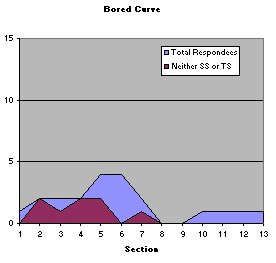 First, thanks to everyone for what I take to be their direct honesty. I could not have come to the conclusion I did without your willingness to let me see inside your heads. I think this is an interesting chart. The blue area is all people that indicated some level of boredom at each section. The red/brown portion is only those who had not read one of the earlier stories. I glean two things out of it. First, first time readers drag over portions of back story I've put in. When the story gets moving, they're interest comes up. And second, the World conference as it is drags people who are already into the world (previous readers) down.The Suspense Curve: 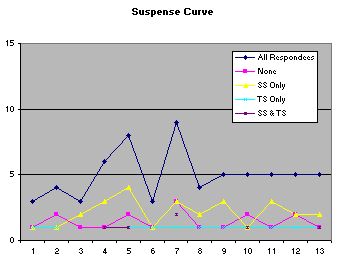 This is another good chart. The blue line at top is all respondees, the other colors denote what previous stories others had read. I like that the numbers rise often through the piece, and spike quite well a couple of times. In particular, those who had read "Stealing the Sun" responded very well, which makes me pleased because obviously, "Parchment" picks up with the same character. That it connects so well with this segment of the readership tells me I did a pretty good job of carrying on the character as I had wanted to. One of the main things I get out of this cahrt is that section 12 needs to be tightened. I think it no coincidence that this line remains steady while the "boredom" curve bumps up a just a tad at the end. this, and a comment or two tell me I probably ought to look at the last 2,000 words or so and see if something's too loose. By itself, though, this chart doesn't tell me everything I wanted to know. It didn't tell me whether this curve was "Good Enough." Scary phrase, eh?Issues: 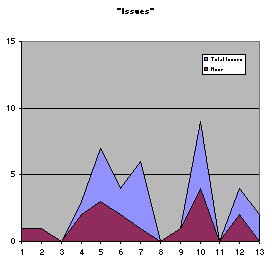 If I do this again, I think I'll change my approach a little. I found the types of feedback I received with the "Ack" and "Logic" categories difficult to separate. So for the analysis, I put them together. When I plotted, the data is intriguing, if not overly revealing. The Blue area is again, all respondents with issues, and the red-brown are those who had never read a previous story. The most interesting part of this curve for me was the total number over various sections. Most of these issues were tiny things that the respondents often apologized for noting. I was concerned about the spikes, though. Too many little issues in places can erode a story just a certainly as too many raindrops can carve up a mountain. How do I assess this? Do I wantonly go in and modify ever part of the story? No. Instead, before making any assumptions, I decided to look at the positive/negative ratio... ... now this is fascinating. [can you tell I'm an engineer at heart?]Issues to Suspense: 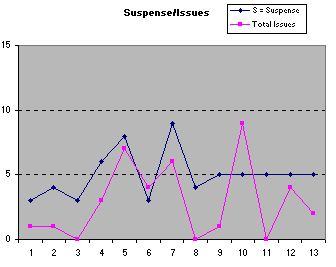 I find this to be about the most interesting chart on the page. Call me an overly analytical dweeb if you want. I can take it. But what this chart basically said to me is that I could probably "get away" with leaving all the issues go except those in section 10 (Which is the conversation between Torrance and Martinez, for those of you who participated). Look at it. Here's a place that's really important to the story, and the people with issues (tiny though they may be), suddenly outnumber those who find the stakes rising. I read this and immediately thought: Something MUST be done here. The End: I asked people to let me know their thoughts at the end of the story. This was, perhaps, the most satisfying portion of the feedback in that I routinely got responses that I was looking for--many specifically noting the desire to read another story. Epilogue: There's more of course. I've got hundreds of little pieces of data that are sifted and diced. Most of the detailed suggestions, I'll admit are not going to be acted on. Those that struck a vein as soon as I read them will be (or have been) immediately fixed. The others were useful to know because they let me understand a section of the readership. I don't pretend to really understand surveying. In so many ways, surveys can lead to the dark side. But I like statistics. Statistics are used because they do say something about the whole. Sorry if that makes you mad. Did I find it helpful. Yes. Did I see places I needed to look at, yes. Did I change my vision of the story? I don't think so. Would I do it again? I don't know. I'll admit, it's a pretty fair chunk of work. But I think the study has helped my writing. If nothing else, it's helped me look at the purpose of each part of the story that is down there. so, the answer to the last question remains: We'll see. Mostly, though. Let me again take a moment, and a little bandwidth, to thank those who patiently worked with me. I do appreciate it. If you have questions, feel free to drop them on the sidebar (or e-mail). I'm interested in any perspectives from the outside, now.   Have a great day.  Your page is a great cure for insomnia, Ron Daily Persistence is © Ron Collins |
|


Time flies, man ... |
BACK TO 
|