Day 4: Justification?
April 4, 2001
7:18 a.m.
|
1,400 words: Mostly new    I don't remember thinking there was anything particularly complex about writing back when I first started. The act of putting words on the page was as basic as white bread, I thought. You sit down. You think of something, you put your fingers to the keyboard, and something comes out. Nothing mysterious about it--nothing even close to controversial. Call it the kindergarten-level vision of the uninitiated. Call it naive. Call it the equivalent of thinking you can become a programmer by reading a hundred "Teach Yourself _____ in 21 days" book you can get bulk rate at Sam's. All I can say in my behalf is that it was fun, and that it worked for me back then--that I wrote something every day, that characters came out and did interesting things, and that I was never at a loss for being amazed at what I could do. I can't say I was very good. Nor can I say I even knew what very good would look like if I saw it. How could I know, after all? I was just a punk pretending he might someday write the great American novel, but it didn't really matter because I loved it, and the words flowed, and as the words came out I realized I loved it even more. Somewhere in there, though, I came to the conclusion that I wanted to be commercial. Yes, I started into this writing gig knowing I could someday be commercial, but I didn't decide that I wanted to be until a year or more after I started creating words. And then I did what I do with anything that I really want to succeed at--I studied it. I broke the profession down like a batting instructor breaks down a ballplayer's swing. I read how-to books, and I tried on different personas and different rules of thumb. A lot of them had merit. A lot of them were SPOKEN AT VERY LOUD TONES OF TYPE. A lot of them were dumb. You want proof, you say? Well, try this on for size...I actually went thorough a phase where I would never use a contraction because I had read somewhere that the reader would perform the contracting action in their heads, so it was better to be "complete" in structure because that's what the reader needed in order to make it work. Sometimes I crack me up. During this time period, I talked to tons of people who wrote for a living. I listened to what they all had to say, and I filtered what was important for myself. I read stories and tried to see what made them work. Orson Scott Card, Mike Resnick, Rob Sawyer, Ray Feist, Dennis McKiernan, Kris Rusch, Dean Smith, Maureen McHugh, Allen Steele, and a ton of others were my laboratory. I bonded with other new writers. I workshopped. I got rejected. I got mad. I got depressed. I pumped myself up in order to keep myself going. I relied on friends to manage this trick when I couldn't do it myself. I got into flamewars online with other writers who thought there shouldn't be rules. Through it all I learned. And through it all only a single thing remained constant, and that single thing was that I continued to create words at a rate I was comfortable with. That rate was usually what others would call "fast." Then Lisa Silverthorne tempted me with the concept of the Dare. Wow. 60,000 words and a complete story in a month. Just the idea made me quiver in anticipation. Could I do it? I didn't know, but you could have powered the entire dot-com universe for a month off the energy I was radiating in the days after she threw down that gauntlet. Here was a project worthy of heroes. Gervase commented in yesterday's sidebar--something that I've come to appreciate because he (she?) never fails to draw a tiny bit of blood with his perspective, and so I know that it's a perspective that holds merit. His comment suggested that writing this book as a Dare was as a stunt, and that it might be best to keep under wraps that I was doing things this way because no one wants to read a piece of tripe that's been put together in a month. I'll touch base on this again in a bit. But I wanted to say that in a very real way, Gervase is right. For that first Dare especially, he was so dead on. The first time I did a Dare, I was doing it for no other reason but to prove to myself that I could. The act itself created a circus atmosphere in my mind that I reveled in. It was cool. It felt unique and powerful and incredibly freeing. It was like turning a double play on the softball diamond--which is hard as hell, by the way. My blood boiled, and my hands sweated when I thought of the idea. So I can't argue Gervase's point. It's a good one. Okay. Time for a break. When Lisa and I were first married, we found ourselves occasionally getting on each other's nerves. I know anyone who's ever been married out there will find this hard to believe, but living with someone is very different than dating them. Things change. These changes have very little to do with what happens when you're out watching movies or having dinner or doing the bar-b-que thing with friends, and a lot to do with what happens when you're cleaning up after dinner or leaving toothpaste in the sink after you're done in the morning. I, as you probably know, am a male. This means I am pretty much unable to remember anything someone tells me about how something should be done unless I already agree with it or unless I have this burning desire to make something of the advice. I will, instead, do it my way. For example: In the early days I remember Lisa would occasionally point out a method she used to optimize how the dishes would fit into the dish washer. This process would start with her calm and rational suggestion that the short juice glasses work best along one of the upper rails, or that the saucers should go somewhere specific so the water would be better able to circulate through the machine. A few loads later, when it became obvious that this training hadn't sunk completely in, she would go out of her way to physically show me what she meant. And then a few loads later, when it still became obvious that nothing was changing or when I would grudgingly follow the process for a few days then regress a bit, she would basically store up this little incapability of mine, and I would eventually hear about it at some time period when I was due a good virtual slap upside the head. [ Hi, Cutie. Have I told you lately how much I love you ? :) ] The problem here was threefold. First, the danged glasses came out clean pretty much wherever I put them--at least I couldn't tell a difference (still can't, though you might argue that this just proves I lack sufficient genetic material to see into the specturm where dirt is so obviously visible). Second, I have to admit, I don't get too hopped up over various advantages of loading the dishwasher. I know it's important, and I know there are better ways of doing it. It's just that my brain only holds a few bytes of data, and I've never had the desire to have any of my grayware filled with optimal dishware loading methodologies. Of course, you can ask me anything you want about Steve Jeltz or Jose Offerman, and there was a period of my life where I could have told you exactly how many hit dice a shambling mound should get--but those things are for a different day's entry. More important and more germane to this already overly long piece, is that I have a personal problem that can be summated as follows: I have a classical male need to feel successful at whatever I do that translates into needing to do things in ways that I feel comfortable doing them in. In other words, I like to be in charge. See, that wasn't so hard to say, was it, Ron? Maybe this is why I'm a project manager at work. I like being in control. I don't like being partially in control. Perhaps I'm overly confident of my abilities, but I think history shows I'm a pretty capable person. If I'm in control of a process or a project, it's usually successful. This relates to the whole dishwasher thing because what Lisa didn't understand was that by telling me I wasn't doing things right, and proving it to me over and over again in tones of increasing sarcasm, she was unintentionally saying that I was an unsuccessful slob who couldn't manage to get a glass clean if his life depended on it. On good days, this resulted in me figuring she was right, which (of course) gave me great thrills at any future loading opportunities that came my way. On bad days, it just made me angry. I hear you. What the heck does this stuff have to do with writing? Are you planning on the herculean task of loading a dishwasher in a month, or what? Well. After all the work I've done over the past few years, I've come to a place in my learning where I understand a few things as they relate to myself. This place that I've come to may not work for you. In fact, you're probably lucky if it doesn't. I wouldn't wish the various uncertainties of my place on anyone. But this is my place, and since it's my place I'm kind of fond of it in that "It may be a sty, but it's my sty" kind of way that can make me get a little defensive when someone points a finger at me. For me, the place is this:
As I said earlier, the grandstanding element of the Dare was an element of allure for me in the first days of my "career." The Dare called to me like a Siren back then. It provided me the platform and the challenge I needed. But I'm older than that now. I understand more about how I am as a writer, and how I go about creating. This is me. Caroline wrote in her journal a few days back that she's come to the conclusion that she is not Toby, and that she is not me. Well ... I'm not either of them. I'm me. I write a lot. I throw away words, and I write again until I get it to a point where I think a story is right. Sometimes this happens on the first draft, and it's one of those great three hour gifts of power that goes on to sell the first time out. Sometimes that first draft is tripe, and it goes into revision city and gets stuck in some loopy intersection and never comes out. This may be ugly, but it's how I do it. If I don't write a lot, if I don't push myself to produce, my words come out deformed. Gervase is right about a lot of things he points out, though. People who don't understand how I write, or who haven't been around this site to understand my approach could very well look at my work as sloppy if they think it was done in a month--despite the fact that I've been just as open about the fact that it's a DRAFT in a month, not a book. If you've read these pages for very long, you've seen me write stories in days and you've seen me struggle over them for weeks. The only Dare manuscript that--to date--I've brought to a place that I think is marketable took me something over three months of work spread out over maybe nine months of time, and I'll almost certainly give it another couple week pass before marketing it again. (I decided some time ago to hold onto it for a bit for a totally unrelated issue--ask me sometime at a convention if you're interested in more details). But the words Dare, and Month are all that people remember, and that can be a real problem in the court of public opinion. He's right, also, in that fact that there's little honor in writing a trunk book in a month--though I'll say I think it doesn't hurt anyone new to waste the effort trying once ... heck, it's only a month. I waste more than that on a lot of my short stories. And he's right in the fact that as a part-timer trying to claw my way into the secret hide out of professional writers, I've got to concentrate fully on quality and make the most of the opportunities I have. The world is not kind to new writers, and there is a definite idea that "fast" writing is by definition bad writing. This last bit is the one that brings me anxiety in the quiet moments when I'm wondering why in the world I bother to even try, because I write as I write. I can't really change that. I understand that better now than I ever have. I'm comfortable writing a lot, and I'm more creative writing to a deadline. I fully admit, however, that when you write this way it's easy to fall into a matador mentality and look at a manuscript that you know needs more work, and decide that you're sick and tired of it, and that you'll settle for sending out work that is less than your best. I've done it before--but hopefully I can say that it was all a part of my learning curve that, like dealing with acne and braces, I've left gleefully in the past. I'm not blind to that fact that my process can brand me, regardless though. So I'm faced with the weird dilemma ... will the fact that I write best when I write a lot work against me? If so, should I hide it? Should I slide this characteristic of mine under the rug like a pile of dust I've swept up from the corners of my darkdark basement? The answer I've come up with is: maybe. I had, in fact, almost planned to not post that I was writing a book this way again, specifically to avoid the negative baggage that can be associated with it. But in the end I decided that I would rather just be me. And so I decided to go about it in my own fashion, as if it's regular business. No special Dare Pages. No great fanfare. Regular entries into the regular journal that is documenting a regular new writer doing what he does in the way that he does it. Maybe it's a mistake. Maybe it's not. All I can say is that what you see is what you get, and if I'm not good enough, well ... then I'm not good enough. In the end, I expect that the writing itself will tell that tale. I expect people in the industry will either respect me for my work, or they won't. I expect readers will like my stories for the words on the page or they won't. Regardless of all that, I expect I'll still come downstairs every day to create words in whatever fashion I need to create them. 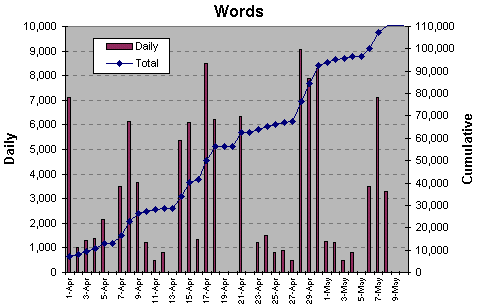  Sensitive today, eh? Daily Persistence is © Ron Collins |
|


"I know some great writers, writers you love who write beautifully and have made a great deal of money, and not one of them sits down routinely feeling wildly enthusiastic and confident. Not one of them writes elegant first drafts. All right, one of them does, but we do not like her very much." Anne Lamott |
BACK TO 
|