(…or Going Back to the Basics)
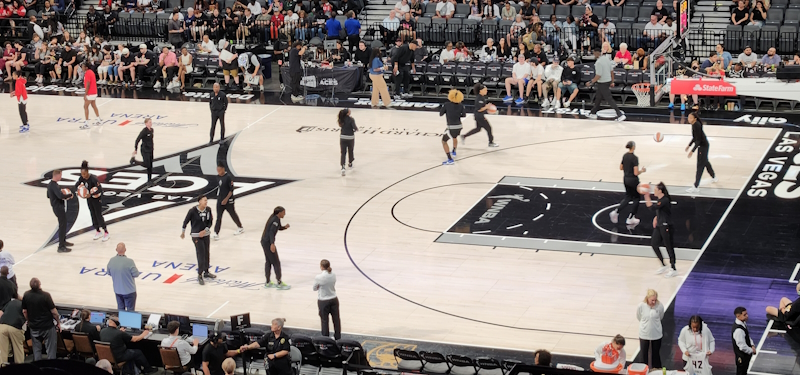
Lisa, Brigid, and I hold season tickets to the WNBA’s Las Vegas Aces games. If you follow “The W,” you know that it’s been an interesting season for the team. They started with high expectations, and promptly set about NOT fulfilling them. These things happen sometimes, and when they do, everyone looks for a silver bullet. You know what I mean, of course. Everyone wants there to be one thing that doesn’t play right? One player, or one scheme. One light switch that, if the coach hits just right, the team will right itself and everything will go back to being proper. Alas, the world is more complex than this.
A good performance of any kind is based on a million little things.
As Michael Jordan once said, “Talent wins games, but teamwork and intelligence win championships.” To this you can add Bill Walton’s comment that “Winning is about having the whole team on the same page.”
There’s a lot packed into those ideas.
What does it mean to get on the same page, after all, and what steps do you take to make that happen? Dealing with multiple personalities with multiple talents is a complicated thing. To watch the Aces put it together this year (which they have) has been somewhat of a joy. There’s still a lot of time left in the season, but as I’m typing the team (which some thought were possibly not even going to make the playoffs earlier) has worked itself into a position to take one of the upper-tier positions.
They’ve done it through a lot of hard work. They’ve done it by not panicking.
They’ve done it, as far as I can tell, by going back to the basics.
During one of the darker moments of the season, a friend of mine asked what I thought the team needed to do to stop the bleeding. I sidestepped the question, but they pushed again. So, I said I thought it was time to do just that—go back to the basics. At the time, I mentioned how the great John Wooden was famous for starting the season by instructing his players on how to properly tie their shoes, a practice that came along with the foundational idea that everyone would be staring over again, and that attention to detail matters. Sure, everyone knows how to tie a shoe, but the basics are the basics, and you need to pay attention to those basics together if you’re going to win.
Challenge everything.
Deal with what you can control.
Start by tying your shoes.
Everyone. All together. Tie your shoes.
I’m thinking about that right now because there is a weird relationship between a basketball team and a writer. Or at least there is a weird relationship between a basketball team and the writer that is me.
It goes like this…
Some time ago, I wrote about how my brain works—specifically regarding what some of my friends call “Creative” and “Critical” Voices. I said that I never really separate my creative and critical components as I’m writing, that for me to do what I do, I need both to be engaged. They do, however, need to be working with the same goal in mind, or, dare I say, my Critical and Creative Voices do, however, need to be on the “same page” about what the goal is.
As long as this is true, everything works out great.
Hence, I introduced a third voice into the mix—the one I called my “Babysitter Voice,” and who was assigned the role of mediator and tasked with making sure the cycle ran properly.
Since then, I’ve presented this model to a few other folks, and with their responses in mind, I’ve added more nuance and even a fourth brain.
Specifically, I renamed the Critical Voice to the Curator Voice, because that’s what this piece of me is really doing. It’s working with the raw creative side of things to make sure it doesn’t go off the rails so far that it’s working on something else…or, if the Creative Voice does go off the rails, the Curator Brain is what recognizes it for the brilliant divergence that it might be, and then actively urges the Cretive Voice to go even further!
Everyone needs a good bad influence, right?
The Curator Voice can sense something great is about to happen, and makes sure it does, indeed, happen.
In doing this, though, I’ve also added a new brain, that being “The Asshole Voice.” This is the piece of my mind that whispers horrible things to me about how meaningless my work is. My Babysitter Voice’s job remains technically the same, but the skillset it needs in this model is broader, because now Babysitter Voice needs not only to moderate, but to be able to completely block the Asshole Voice while also ensuring the Curator and Creative Voices stay on working terms that are good enough terms to keep me moving forward.
Yes. I may be weird, but it is what it is.
And from comments I’ve had from other writers as I’ve described the framework, I’d guess you are more like me than you might think, but just have never felt the need to break things down like I feel. The analytical aspect of my ideation bent requires me to pretend I can model everything now, doesn’t it?
This works for me, though.
I’ve felt the truth in this model deeply as I’ve come back into productivity over the past few months. The Four Voices Model explains a lot of my progress because the fact of the matter is that, when I tried to just hit a switch and jump right back to where I had left off, my voices were officially “Not on the Same Page. And being officially “Not on the Same Page” meant the Asshole Voice was able to grab purchase.
That’s the thing about playing in complex worlds. When a team is winning, everything is easier. But when the team isn’t winning, the darker voices find cracks in the foundation so much more often.
To make things work for me, the Babysitter Voice had to take us back to basics.
Had to focus on the details.
Had to force us to make progress one step at a time. Learn to tie our shoes together, as it were, then go to the next level. Creative Voice, meet Curator Voice (putting arms around shoulders). You guys are best friends, right? Let’s talk about things a bit. Here’s a word. Pass it back and forth. Don’t worry. I’ll make sure you get it back. See how it feels?
Every day.
Just for a moment, the Babysitter would remind the Creative Voice and Currator Voice why they needed each other, and how great things were when they could pass the words back and forth from session to session. The Babysitter worked to remind each of them how trusting the other made everything work out so much better. Babysitter Voice also promised them that Babysitter Voice would slam the door on Asshole Voice any time AV tried to slip out of the shadows.
Trust ourselves, Babysitter Voice would say.
We’ve been here before.
We know what we can do when we’re together.
Win or lose on any particular day, we know how amazing that can feel.
“Start by writing me just one sentence,” Babysitter Voice finally said. “Just one sentence—do that and you can both call it a day. But it’s got to be one that you’re both happy with. One sentence that brings you true joy, and you can go on to whatever.”
Back to the basics, right?
It’s no surprise then that I began to write a lot of words.
A half hour before every game starts, the Aces (like all teams) head out to the court and have a ten-minute warmup session. When that’s finished, they go back into the locker room for a chat (or whatever?) and return in the last five or so minutes for a quick shoot around. Overall, the process gets them loose and ready to play.
We get to the games early enough that we usually see this process.
A week or so ago, I really focused on that first session.
It was an important game, you see. The story of the season was on the line. The team had fought to get to the place where another win would give them a little breathing room on that coveted playoff slot. A win would be a big deal. A loss would break the momentum they had built and plunge them back into a fight for survival.
On top of that, the opponent that night—the New York Liberty—was formidable.
Tension was up.
So I watched that first session closely.
It was full of little mini-plays. You know what I mean, right? There are permutations, but they all look similar. Pass to a teammate, take a path, pivot, then cut to the basket. Receive a pass from the teammate—usually a bounce pass—and score. Then grab the ball and get it properly to another teammate so someone else can run the drill.
“They are super-sharp tonight,” I said to a friend who attends with me.
And they were. Really. Sharp.
Every player was hitting the same mark. The pivots were precise. The passes were perfectly placed to allow the shooter to score in flow.
Sure, it was just a warm-up drill, but everyone was so clearly on the same page.
Five minutes later, the players huddled and performed a little clapping routine before leaving the court. When they arrived for the second set, they were less regimented. Just passing and shooting. But the balls were going in quite a bit, and if you know basketball, you know that, as Brigid, Lisa, and I will often say to each other, “Ball Go In Good.”
It was a hard-fought game. Not everything went right because, when you play a good team, sometimes the other players do good things, too. But the defense was solid (which I suppose is a measure of whether basketball teams are, indeed, on the same page), and every player who took the floor did something positive. Though Ball Did Not Go In as often as one would like, the Aces won most of the other stats that you might want to look at: rebounds (check), steals (check), turnovers (check), free throws (check, check).
When the dust had cleared, the team walked away a three-point victor.
They earned that one, I told myself as I left the arena that night. I felt good about it, too. It’s fun to watch a team come together like that. All the voices lined up together.
All the Voices on the same page.
It’s magic, you know? When things are working?
Really, it is.
But underneath that magic is a whole lot of other things, all of them working along at their own thing, all of them important in their own ways, even if you don’t exactly see them all the time.
It turns out John Wooden was right.
When things are going wrong, you can do worse than go back to tying your shoes for a bit.

I am a human. Not an AI. You can tell because keep a Patreon page where I talk about writing and being a writer (among other things). In other words, I post there first. I also share occasional work in progress for Patrons only. If you’d like to support me–or just this blog–you can do so there.