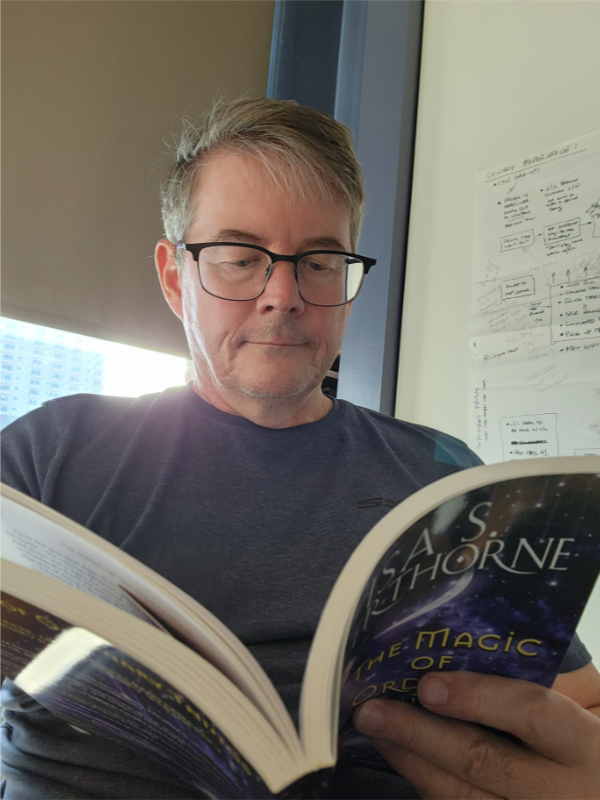
A few weeks back, I came across information that said Dan Brown, the bestselling thriller author, does not read fiction. I thought that was interesting because the rule of thumb beaten into us is that writers must read. It’s a rule of thumb that seems so obvious as to be barely worth arguing about, but at the end of any analysis, it is still a rule of thumb rather than an absolute edict. People are gonna people.
In an attempt to confirm or deny the information, I did a little Googling but came up empty. On a lark, I asked ChatGPT about it, and came up with the answer that it is true: Dan Brown very rarely reads any fiction at all. As an aside, before you get going, when I asked for links that would confirm Chat’s answer, it gave me a nice list that, when followed, did, indeed, confirm the statement. Or at least they confirmed what Dan Brown says, so it’s as true as you can trust him to reveal himself.
Which is the thing about inner truths we state to the public, right? They wind around themselves, and we wind up trusting people at face value when it’s even possible that they don’t know what’s true about themselves…
But that’s not what this little essay is about, now, is it?
While Dan Brown says he reads a lot of non-fiction, he says he doesn’t read fiction because he doesn’t want it to mess with his own creativity, which is cool, too. I totally get that. There are times when I don’t want to read fiction for that reason. I also have specific writers that I’ve taught myself to avoid because they will make me want to write like them. My personal bugaboo in this category is Harlan Ellison, a guy I adore reading, but who then seeps into my fiction in ways that are not authentic to me. I am, it turns out, no Harlan Ellison.
But that’s not really the question, is it?
Let’s peel an onion a little, all right?
Let’s ask a question about the rule of thumb, that being: Why do people say that to write fiction, you really must read fiction?
It’s a question with multiple answers that could include things like the need to keep up with the field or to continue your learning. I have a friend who is an established writer, and who reads voraciously for that reason, and even recently went semi-public with having followed the old exercise of spending considerable time retyping large passages of another writer’s work to get the feel of that writer’s prose instilled into their framework.
Both of those are fair reasons, but not mandatory for becoming a successful writer. I can argue, in fact, that a lot (most?) really successful writers don’t follow anyone else’s framework, nor do they need to worry about anything going on in their fields. A lot of the names I’m talking about are people establishing their fields, after all. Why do they care what someone else is doing?
I think it’s fair to say that these individuals are not required to read.
But, to me, those are not the answers that matter.
The answer to my last question that matters (why is it important that a writer of fiction read fiction) is that reading fiction—or otherwise absorbing fiction—is the very best way to understand Story.
This is why, when a New writer…
…tells me that they don’t read fiction, I strongly discount their chances of success. Is it possible that a kid coming up the ranks could end up with a beloved bestseller their first time out? Well? Um…yes, I suppose it’s possible. An infinite number of monkeys with typewriters will theoretically create a masterpiece eventually. But that’s not likely.
Because if a kid has not absorbed themselves into Story, then they are unlikely to be able to tell us a story that we want to read, and we use the writer’s reading history as a de facto credit in this category, a degree of sorts. When my daughter writes her fantasy, I know it’s coming from a background planted with Tamora Pierce, Patricia Wrede, J.R.R. Tolkien, and a bunch of others. It is my opinion that my daughter Brigid was so good, so early, specifically because she understood Story to the core of her bones.
Of course, there are other ways of absorbing Story.
Movies and TV are modern methods. One can get a great education about basic story structure by simply mainlining sitcoms.
Talk about your character in a setting with a problem in the first third of story, with a series of try cycles in which things always get worse in the middle until finally, with everything on the line, the final try cycle resolves into something with a message. It’s all right there, correct?
So if a person has fed themselves this as the basic idea of learning Story, it can work just fine. The issue then is translating that inherent understanding of Story to prose, which is a much less audacious goal than actually building stories from the ground up.
Likewise, the old-old-olden days of narrative storytelling consisted of humans passing down storytelling in oral fashion. No reading at all. Arguably, writers like Mark Twain grew up learning Story from other human beings, right? I’m sure there were books in Samuel Clemens’ life, but you get the point. He’s a classic for a reason, and a lot of that reason is his narrative style.
So, no. It’s not required that a writer of fiction read fiction, but it’s definitely a requirement that a writer of fiction learn Story (among other things). So, it’s natural to expect a writer of fiction to have used a large part of his or her notorious 10,000 hours of deliberate practice required for becoming a writer in the act of reading.
And, oh, by the way, asking ChatGPT a few more questions led me to other sources that said that, yes, as a young kid, Dan Brown read the Hardy Boys, and that, yes, after college, Brown read at least some fiction, including books that turned him onto the whole concept that he could write books himself.
So, it’s not true that Dan Brown never read fiction.
Only that he does not read it now.
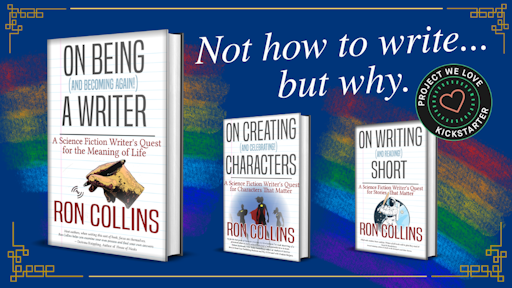
My next book, On Being (And Becoming Again!) A Writer — A Science Fiction Writer’s Quest for the Meaning of Life is a Kickstarter “Project We Love!”
Launching March 24th!