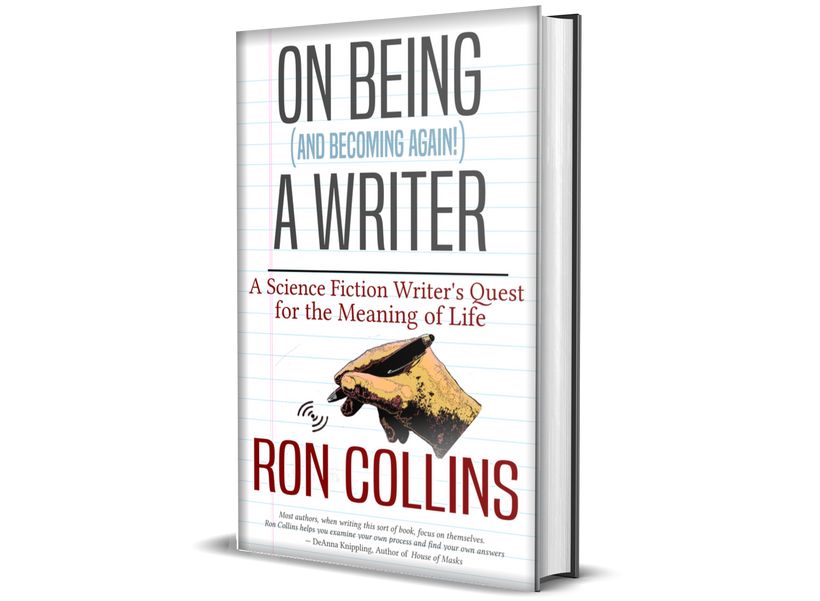
I’m not sure what to talk about today. There’s so much going on around me, and my brain isn’t settled into whatever a “normal” cycle is—partly because I’ve recently been absorbing a lot of information about writing from a lot of different sources. One might think paying attention to a lot of writers is good (and it is), but you can go too far. Eventually, you just have to do the thing, right? Eventually, a writer just has to decide what they are going to do and then go forward.
This process of forging ahead is a skill of its own.
It’s a behavior that matters.
Perhaps oddly, I’m thinking about this now because I came across a dozen-year-old video by Veritasium that discusses cognitive biases. That might sound like a strange segue, but it isn’t. Our biases (and those of others!) affect everything about ourselves, and in the case of this essay, specifically how we learn.
The video is very short. Maybe five minutes tops. And it’s fun.
It’s also going to matter here.
So, go ahead and watch it.
I’ll wait.
Some time ago, in response to my friend Dean Wesley Smith’s commentary in which he said he felt sorry that they were getting such bad advice, I wrote a counterpoint blog post titled “I Feel Great for New Writers.” Dean was talking specifically about how there was such a fervent tendency for certain groups to push new writers into traditional publishing paths. As a writer with a lower profile than Dean, as well as a lower readership, my response was that Dean wasn’t wrong about the morass of writerly advice that was out there, but that, in my mind, I felt fantastic for new writers. When I came up, I wrote then, there was only one path, the traditional one, and if you bounced off that path, you were done. If, however, you talked to any successful, independently published writer today, you’d find there are hundreds of paths to success. Today, I said, if a writer takes one path (any path, traditional or Indie) and bounces off it, they can simply dust themselves off and keep going.
The key thing today is not to quit.
The skillset a modern writer needs, I wrote then, is the ability to sort through chaff to get to the wheat, and then the moxie to develop their own path toward the good stuff. The question, of course, was: “What is the Good Stuff?”
What truths exist to help us find the right way forward?
Personally, I think the answer to this question is complicated.
It depends both upon the system of publishing that exists at the time we ask the question, and also upon the writer themselves, both what skillsets and temperaments that writer has, as well as precisely what the writer wants to accomplish.
For one of thousands of examples, advertising: there are those for whom it’s working well, and others for whom it’s a disaster. Some of that is probably the product itself, some of that is the writers (their skillset in describing their books and running the actual advertisements, their tolerance for loss, and their ability to deal with the discomfort of what it means to advertise in the first place). Some writers swear by the practice, others despise it. And that’s before we get into breaking the world down into flavors of advertising that exist. Amazon, Facebook, BookBub, various promotion sites, and others. They all have their advocates and detractors, and then there are the detractors who will say one should never advertise at all.
So, when it comes to the idea of advertising, who should you trust?
What advice should you follow?
What does it take for a new writer (or an established one who is in reassessment mode again, for that matter) to wade through all the advice out there?
How, exactly, does one go about separating the wheat from the chaff?
Looking at the post I wrote, I realize I never got around to that question, so let me fix that now, all right?
When it comes to taking advice from people, the skillset it takes to sort wheat out is arguably a four-headed beast:
- Assessing the advisor
- Assessing what is successful today
- Projecting the future
- Assessing yourself
Developing this skill for assessment is complicated because the answers you give to these points can be different than the answers I would give, and also because they can interrelate. Your ability to pivot if a decision goes wrong might be different from mine, for example. Therefore, a decision you make might be wiser than a decision I make, even if they are the same decision.
Let’s address these points in roughly reverse order.
Assessing yourself
This is the key to everything. What is your goal? What do you want out of the moment? How much time can you give to your career right now? How much workload can you take and still move forward? Where is your mental state, and where can you find a win vs. feeling like you’re lost? What paths make you excited, and which make you feel like gouging your eyes out?
To say assessing yourself is important feels almost too elementary to include here. I mean, it’s a “well duh,” if there ever was one.
And yet, I think it still deserves to be number one on the conversation tote board.
You are in charge of yourself, after all.
You are the one who gets to live with your decisions, and if a decision you make doesn’t pan out, you’re the one who is going to have to reassess and change paths. If, for example, you commission a book cover (or your book design, or your advertising, or…), and it doesn’t sell books, you’re responsible. As an Indie, you own your product. You get final approval, after all. You’re the publisher. Which, in this Indie world, makes total sense. That is, afterall, the entire point. The good thing and the bad thing about being an Indie is that it’s all on you.
So, who are you? What is your goal?
There is no wrong answer to this, but I think it’s a bad idea to lie to yourself because the answer to the question of how to sort through the cloudy chaff of writerly advice depends on it.
If, for example, you want to write, but don’t want to worry about a long-term career, that decision to accept a sub-par book cover is fine. If you’re expecting your family to buy the book—or even just planning to buy a bunch yourself to give as gifts, accepting something you like is fine. A project of the heart is a different beast. But if you’re trying to build a career, the path to good covers requires a different approach—perhaps first some self-education on past and current practices, some practice as developing an eye for “quality,” whatever that is, and depending on your mentality, maybe even developing some skills to make your own.
Or, if (in this cover design example) you’re a hard no on developing design skills, but don’t have concerns dealing with people, a path that accentuates learning how to contract and work well with artists is something that fits your mentality better.
Know thyself, all right?
Are you a person who sticks with things until they are done, or are you a person with such bad shiny-object syndrome that you need to limit your decisions to shorter-hit ideas?
These things matter because if you come across a new tool or hear an expert advocating things that don’t fit your current abilities or mindset, you probably want to ignore them. And, though I’ll have more on advisors in a moment, if those prospective teachers and mentors are advocating things that don’t fit your current abilities and mindset as if those things are the One True Way, then you probably want to run away completely.
You own your career. You own your development.
It’s your job to find the tools, processes, teachers, and mentors who work for you, and developing a business in the arts is not like learning math. There are no deterministic equations. No guarantees. The processes, tools, teachers, and mentors that work for you are the ones that will help you get where you want to go.
So, yes, the first step in developing the ability to separate wheat from chaff in today’s complex world of publishing is to understand exactly what the “wheat” is for you, and that answer is almost certainly different for you than it is for me.
Assessing The Future (And What’s Working Now)
I’ve decided to put the skills of assessing what works now and projecting what will work in the future together because when I attempted to focus only on the act of assessing what was working today, I kept getting tied up in knots. It makes a lot of sense to keep up with the environment, and that means listening to what self-professed six and seven-figure authors are doing. The problem is that we can also get massively derailed when we focus only on whether another writer is selling books today or not.
Writer X runs a $50K Kickstarter, and suddenly, we hear that we, too, should run a Kickstarter. Maybe that’s a good idea. Maybe it isn’t. But Kickstarter is a weird market. For a multitude of reasons, its mechanism works differently for different artists. That said, it’s clear that this is a market that is “working” right now.
Or, is it?
Oriana Leckert—Kickstarter’s Head of Publishing—has often touted the percentage of publishing projects that fund. That number, however, is not 100%. In addition, I personally debate the use of the idea that your project funds as a true metric of whether that project is successful or not. In a recent post of mine, I reported that I spend about 80 work hours to run a decent project on Kickstarter. My profit results in achieving something around minimum wage as a result. Yes, I always fund, but is that “success?” For me, it is, just barely, I suppose. But for a lot of people, even if their project doesn’t crash and burn, that’s way too much work for such a small payoff.
So, is Kickstarter “working” today?
Yes, it is. At the big picture, a lot of writers are making a lot of their living off the platform. It’s completely legit.
But will it be working a year from now?
Five years?
Ten?
I don’t know, and neither do you.
So, if I hear advice that says I should run Kickstarters, and if I feel that the idea fits my basic psychology and situation, then I’m all ears. But if I hear advice that says I should build my whole development and release cycle around the platform—there are, for example, lots of folks who advocate bolting Kickstarter onto the front end of their wide-release process—I owe it to myself to question the idea.
If that’s my new process, how long do I think the platform will be around?
The platform currently takes 8% of a project’s revenue. What are the chances they decide to take more?
The system uses Stripe as a payment manager, and Stripe has recently attempted to restrict which projects Kickstarter can service and which it can not. So, how stable is Kickstarter?
If something goes awry on the platform, how will that affect me?
Can I rapidly pivot?
When I answer those questions, I generally discount issues. I personally expect the platform to be around and workable, and if it dies or becomes otherwise untenable, I don’t mind the issues it will create for me. But you need to answer them yourself. Your business is your business. I have included Kickstarter as a fundamental platform of my business, but not the central core of it. I am aware of people who appear to have made that platform a central core to everything they do, which means that if the platform were to go away, they are going to have to pivot quickly and under pressure. It’s all good, of course. They get to choose what they do and how they do it.
I think that question of the future, though, generally boils down to that one thing: if something goes wrong, how hard will I have to work to pivot?
Another example of this is the Amazon Kindle Select program.
For my two cents, this has been an interesting tool to assess because that assessment has changed over time as writers have gained experience in it. Also, my own observations (which have been made from afar) have evolved my mindset. Regardless, since it’s an exclusive program (if you go to Select, you can’t go elsewhere), this is a big decision.
The good news is that pulling books out of Kindle Select, while definitely a pain, is not impossible. It’s also not required to be all-in (meaning you can choose to include one book, or, probably better, one series, rather than your entire catalog).
The other good news is that for some people, it’s really working well. There Be Money in that environment, anyway, and I’m aware that writers are successfully growing their email lists through the platforms, which means they are increasing their core reader base. The downside, of course, is that the choice to go to Select means you will be behind in developing your reader base on any other platform, so in the case that Amazon either dramatically changes their business proposition—pays less, begins to take other rights, or even goes completely away—you’re at risk for whatever properties you’ve left in that environment.
All this said, if you bring up the idea of having books in Select, you’re going to hear a long list of writers with a long list of opinions about the program. And even now, many years after its appearance, the vitriol can really fly.
My own evolution has softened on it. I still don’t use it. At least I don’t right now, for lots of reasons, but my mind snapped into place when I heard highly successful writer Lee Sevino call it the “busy mommy” option, meaning that a major advantage for going to Kindle Select, especially early, is that it limits a writer to managing only one platform, and that in the case of a busy mom who might be shepherding three kids to school every morning, working all day, and squeezing writing into an hour here or there, the existence of the environment as an effective tool is extremely helpful. At least for the moment.
Yes, perhaps she’ll need to pivot quickly in a year or two or whatever, but that’s a problem that can be kicked down the road, and in the whole of the situation, I can see someone being wise to make that call.
In the big picture, the business of that busy mommy (or daddy, of course) is at some serious risk. But it’s going to be at risk, regardless of the decision to use Select or not. If the writer listens to blanket advice to avoid it at all costs, that might mean they miss an opportunity to make enough short-term money to actually justify quitting the day job earlier (and then work to get their books more properly balanced to wide if that’s what they want).
The decision to pursue a path always comes with long-term ramifications. The skillset you want to develop is to be able to put those into terms you understand and can deal with, and then make a choice that is right for you (which, of course, is up to you to decide).
And that brings me to…
Assessing the Advisors
Here’s where we come to the video from Veritasium.
Biases go both ways.
When we listen to other writers, we respond based on how we’re predisposed to assess that advice, and so it’s best practice to try to check any biases we have so that we can make our thoughts from a clean sheet of paper. But I also think it’s valuable to remember that the sources of information have biases, too, and that those biases can come in several forms. Sometimes a writer is trying to sell a course. Other times, they have an ego wrapped up in their viewpoints. Sometimes it’s both. Sometimes a teacher/mentor’s bias is so ingrained in them that they don’t even see it as a bias.
If, for whatever reason, you did not watch that video, go back and do it now.
Or better yet, here’s the link again.
Once you’ve seen the video, think about the relationship between the new writer and the wild west of advice givers out there, and while you’re doing that, apply the idea that we all carry a bias of pursuing things we simply think are right, because of course those things are right…but consider how this idea of our internal bias applies both to people seeking advice and the people giving the advice.
Think about the huge number of writers out there who are educating others.
How do they go about it? Are they specific? Are they clearly knowledgeable? How transparent are they? Can they give advice across a wide spectrum of writer situations? Do they even seem to be aware that writers exist on a vast spectrum of personalities, skill sets, and situations? Do they present multiple viewpoints? Do they suggest they might be wrong for some writers—or sometimes even just say flat-out that they might be wrong to begin with? Are they respectful of your decisions? Can they suggest other paths than their own? Do they learn from others? What is their background, and are the biases that come from that background present in their position? Do they have experience in multiple industries? Are they actually using the tools or platforms they push? Are they putting out fiction at the rates they say they are, or at the rates you want to? Can they explain “how to” tasks clearly enough that you can tell they know exactly what they are talking about, and if so, how does their position and advice compare to others in the field? If they are arguing vehemently against a tool or a platform, have they actually tried it, and can they explain why it doesn’t work for them in ways that feel true?
The questions are wide-ranging, yes.
But it’s your career. Learn to listen. Learn to question. Learn to hold onto the pieces of what an expert says that work for you, and let go of the pieces that don’t.
People giving advice—including me—almost always think they are right, after all. This is the exact definition of a bias. And given the complexity of this world of publishing, it’s fair to say that a writer giving any piece of writing advice is never right for 100% of their followers. All you can say for certain is that they were right for themselves. If that.
And any successful long-term writer has pivoted many times—hence following their path was “wrong.” But not really, of course…which is really a big part of the point of this essay.
So, in the context of this essay, a writer’s ability to sort wheat from chaff when it comes to finding advisors that will help them is to put some distance between themselves and the advisors they are listening to, and exercise the ear of a skeptic. As that Veritasium video suggests, we need to ask questions that get to a “no” so that you can get to a deeper truth that fits you and is therefore more valuable. Realize that advisors, too, are presenting information in ways that simply obey their own worldview.
Which makes sense, right?
The idea is true to them.
Why would they think otherwise?
But for every piece of advice that an established writer can give you, I think it’s best to realize that you can find examples of people being successful without doing this gig the way that expert is touting it.
Go out and find those examples, too.
Because those examples are what prove there are no “wrong” paths, only paths that work for you or do not work for you. The goal is to be diligent, to be aware, and to make decisions based on a solid foundation.
The goal is to do your homework.

If you’ve been around me for any time, you know that for the past many months, I’ve been going through another phase of reassessing my own writerly world. Some of those wanderings are embedded here in earlier posts, and some of them found their way into On Being (And Becoming Again!) A Writer, which will be kickstarting in about three weeks.
Feel free to follow the project if you’d like.
Even just getting notified can help me out.