Let’s get this straight right up front: I wish we were not in a world where we had to talk about artificial intelligence in writing. I mean. Life was simpler before AI came into our lives, or at least it was a lot less chaotic. I am futurist enough to get interested in what AI will help us do in the big picture, but artist enough to wish it wasn’t dabbling in my world. And I completely feel the massive complexities and anguish inherent the idea behind Artificial Intelligence in whatever I’ll call art.
I wish it were not here.
But we live in this world, and in this world, AI is what AI is.
So, here we are.
But a few days back came a meme targeted at people who use AI that exposes what I consider to be the core of a bigger problem, and that is the “pretentious elitism” (he says in a pretentiously elite way) of people who have made it into the hallowed grounds of traditional publishing—writers who for some time I have been calling “dependently published.”
I’m calling it that because that’s what they are.
They license rights to their work and sign contracts that make them mostly dependent upon the publishing house for their careers. Sometimes that works out for the writer for a long time. A lot of times (most times?) it does not. There are, of course, a lot of great writers who choose to be dependent on traditional publishing houses. There are also, of course, a lot of not-so great writers who take that route. Just go to a bookstore and read the beginning of books at random and you’ll understand this is true. We’ve all read a book out of <insert publisher here> and thought it was horrible.
But, you see, there’s this thing about being in the club of dependently published writers.
Being in the club means at least one professional editor liked your work.
Hooray!
Apparently, however, this is all that’s needed to allow many of these writers to consider themselves superior.
Yesterday I wrote a piece that focused on AI as a whole and touched on AI in writing. I ended that piece by hoping we end up in a world built on flexibility, nimbleness and compassion for each other—specifically because it is my opinion that the final arbitrator for the use of AI will be the reader. In the final analysis, this is how it is now and is how it will be forever. In certain ways, this is the primary advantage that going the route of being dependently published gives a new writer. If nothing else, the publisher will make a bit of a print run and will push a new writer’s book to a degree that, even if small, is almost certainly more than the new writer could do by themselves right away (key words: right away).
But the world has run along far enough that we know that’s really not as huge of an advantage as one might think, and comes with the baggage of the new writer losing control of a lot, or all, of their copyright. In today’s world there exist many independently published writers who are releasing very good books, and as a result, independently published writers are now often out-earning dependently published writers. It’s to the point that you would think that dependently published writers, especially young ones with a lot of career left ahead of them, would be scratching their heads and looking quizzically at indies to decide when and how to jump ship.
Alas, while maybe it’s happening a bit, this view toward conversion is still pretty rare.
Along comes the meme in question.
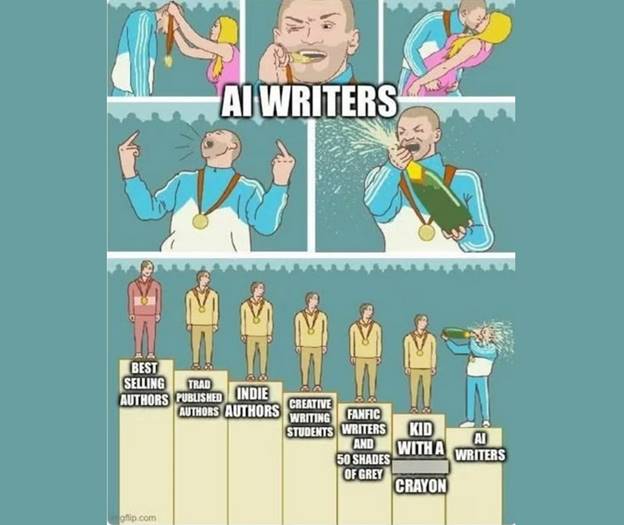
Odds are you’ve seen it, but I’ll post it here just in case:
If you know me at all, you know that I pretty much never call anything “stupid.” I find that tendency to be bothersome on several levels, even when it seems to be well-used. It is just not in my wheelhouse to point that word at much of anything.
The meme is, however, at its roots, stupid. It ignores the obvious complexity associated with the ideas behind AI in art, which in memedom is a feature not a bug. Memes are effective because they put a laser focus on one thing and hype the humor. This particular meme is an attempt to make people using AI in their writing look stupid—as if there was only one kind of person using AI.
As always, of course, since I live in this world of AI, I now need to disclose my own actions and thoughts with regard to AI and my fiction, which is that I do not use it. I like making my own stuff up, thank you very much. It is, for lack of a better phrase, “fun” (or at least satisfying) to make my words myself. Also, at present I wouldn’t know how to go about using AI to create fiction if I wanted to. I am, however, not particularly concerned about others doing so and I grant that if they have a strong vision they could use it in ways to make good art that is theirs. I’ll touch on my views of copyright in a bit.
The meme is kind of funny, I suppose.
At least it’s well-structured to be funny in its own ironic way.
Let’s start with the fact that I personally would put a dependently published writer of a crappy book that doesn’t sell well on that lowest pedestal. We’ve all seen dependently published writers who get full of themselves, walk around beating their pumped-up chests then, three years later, are just gone. I generally view those stories as sad, but when they’re assholes it becomes hard to have sympathy.
But look at that podium.
Check out 50 Shades of Gray down there under Fanfic Writers. E. L. James is a bestselling author. She created a phenomenon. She made a lot of readers happy. Using that as a metric she belongs on that top pedestal. But, no, the meme-maker has decided that this specific bestseller does not qualify as being a bestseller.
The use of “Kid With A Crayon” is kind of funny. Kudos there.
We take a stair-step up then to Creative Writing Students.
Cool. I guess this tier is supposed to represent the unpublished who are still learning?
I dunno. This is stupid.
There are Creative Writing Students who do Fanfic. What bucket do you put them in? Or what about people who write Fanfic, especially those writing fanfic with the author’s permission) but do it so well they create a following? There are also Creative Writing Students who Indie Publish. And … well, you get the idea. But it’s obvious that to make fun of writers who use AI in any way, this meme-maker needed a hierarchy of pedestals, so let’s light this candle.
Once you start looking at it, it doesn’t take long to figure out that the primary point of the thing is to put the dependently published writer at the top of the podium (and that at least that E.L. James-less Bestselling Author tier at the tippy allows some degree of stratification).
As an independently published writer, I guess I should be pleased that I am placed above Creative Writing Students, Fanfic Writers (and E.L. James), and A Kid With a Crayon. But again, that makes no sense. There are amazing independently published writers, and crappy ones (or ones just learning). Just like there are in the dependently published pool.
Then let’s look at that top tier—Bestselling Authors. Both of my main series have been labelled as bestselling on multiple platforms. I am an independently published author. Where do you think the meme-makers bucket me? Based on the E.L. James call-out, I can make an assumption.
This is just a stupid, stupid meme.
The entire pedestal scheme is stupid.
Here is the bottom-line truth (Again): The ultimate judge of quality is the reader. The ultimate path to success—however any kind of writer defines it—is to find readers who like their work. This is the case now, has always been the case, and will always be the case. The ultimate “judge” of art is always the admirer of that art, and an artist of any kind succeeds or fails based on the size that pool of people who are admirers of their work (and, I suppose, the artist’s opinion of that size).
At some level, even this stupid meme understands that.
It starts, after all, with someone (I’ll assume a reader) gifting the writer with a ribbon (let’s call that a 5-star review). That the writer turns into an asshole is not a trait limited to AI-assisted writers. We’ve got them in the Indie world, too, and I’ve already commented on dependently published writers I’ve seen behave that way. The idea of the snot-nosed Creative Writing Student is cliché.
This means that writers calling other writers names (he says as he’s calling this meme-maker stupid) is just … well, at best it’s meaningless.
Assholes of all ilk aside, writers should celebrate writers.
I mean, Book A might not be my personal cuppa, but if the writer does such a great job that Book A enriches its reader’s lives, then, I don’t care how they are published I’m going to say that’s a good writer. If they used AI to do it, then that writer has found a way to infuse themselves into the work far enough to create an audience. I can say that because since, as the world stands right now push-button AI is literally unable to write exciting prose without human intervention, and I actually believe that readers will not respond well to a book that’s been created fully prompted by AI and then pushed out the door. Of course, the reverse of this is then true, too. If a group of readers like something, it’s almost certainly got enough human input to be considered theirs. If you believe that, too, then AI work with no humanity poses no threat. If a writer is feeling threatened, then I question whether they really believe they cannot be replaced.
Say it again: the reader is in charge.
The reader gets to decide what is good and what is not.
To think anything else is to disrespect the reader.
It goes without saying these days that there are a lot of independently published writers who make a lot of readers very happy. These are exceptionally good writers. They fit fully on that bestseller pedestal. There are also lots of exceptionally good dependently published writers who do fantastic work, yet don’t’ get the same sized audience that E.L. James, or Clive Custler, or James Patterson, or whoever does. Success is both elusive and hard to understand except for the fact that every success is a result of hitting a readership at the right time with something they wind up loving.
The questions then are ones of sales vs. dollars vs. reviews vs. longevity.
As a writer/artist, what are your goals? How do you define quality. How do you define success? What are you giving your readers to make that happen? This is a really complex line of questions, and the fact that every writer who walks the earth can have a different idea of what they want out of their art doesn’t make their answers any easier.
Among the first barriers I ran into upon deciding to try to write as a profession were blocks of the community of writers defending their turf on whether I was allowed to include myself in their midst or not. Was I a writer if I merely wrote something? Did I have to get paid? If so, how much? Or for how long? Or for what?
The main reason I left Science Fiction Writers of America the first time was that it seemed to spend 75% of its time trying to keep people out of SFWA. The effort expended was amazing, and the arguments tiresome. This meme is just another drop in the endless stream of such infighting and gatekeeper neep that I’ve encountered over most of my career.
Look, for example, at the way the meme uses the term “Author.”

I noted above that I would comment on the copyright bits associated with the use of AI.

If a writer of any ilk wants to make the completely valid argument today that copyright issues still exist around certain uses of AI, that’s obviously fine. I’m a writer. I hope that writers get paid properly for their work, though I suggest that the latest fair use rulings to date suggest that we will not be getting paid unless tech companies took books from pirated site (which they obviously did). Even then, however, we may not be paid. One of the judge’s comments suggested AI companies efforts my mitigate statutory damages…which I admit I find confusing, but we’re talking lawyers, judges, and copyright law, which is always so straightforward, right?
Life is complicated and people with money move in mysterious ways.
We will see what happens.
But the core idea around the ruling—which will, of course be appealed, which then means we don’t have the “real” answer, yet—is that the idea of taking a physical book, or a DRM-free version of a eBook that’s been legally acquired, or scraping freely available material from the internet, scanning them, and then using that to train an LLM, is fair use, primarily due to the LLM’s massively transformative nature. If this stands, it means—as I understand it today—that the core idea behind AI engines is here, and it means we are going to have to come to grips with the idea of AI-assisted artists in every field.
The questions that follow about how and why writers get paid in the future and what it means to license material will get interesting really fast.
What will that mean?
Well…as a friend of a friend of mine (who is a copyright lawyer) has said, this is a copyright lawyer’s gold mine.
It will also mean that artists of all kind are going to have to come to real grips with the impact of human-driven AI in our fields. At present, the material that comes out of an AI machine will not be awarded copyright—but material that includes AI-generated material can still be copyrighted to the extent that a human is involved.
And as another copyright lawyer I heard recently say, limited copyright protection is still copyright protection—hence the gold mine, right?
Things are going to get complicated.
But the good news remains this: That whatever answers come in the next few years, I continue to believe that this much is true—as it always has been: The reader/admirer will be the final arbiter of what they consider to be good. If readers like AI-prompted work, or AI-assisted work, they will buy it. If they don’t, they won’t.
As proof, I put forward the point that this is already happening today.
Will this make it harder to be a prospering writer going forward?
Maybe.
Probably, even.
But the real answer is that I don’t know. It’s already a hard slog to get people to read my work, but the indie mindset is one reader at a time, and I don’t see that changing. If my competition is raw AI, well, I’ll take that bet.

Regardless, in the vein of writerly infighting, by their podium ranking whoever made this meme is simply saying the quite part out loud, and in this case the quiet part is that dependently published writers continue to see the rest of the world as a threat and continue to see themselves at the top of the chain that is being threatened.
I’m glad, however, that a bulk of readers have seen the bigger truth, though.
In this day, if a writer wants a long and robust career (rather than wants to simply to publish a book or two and move on), readers have now made it such that if you develop a prudent toolset—which is not that hard to do—and remain nimble, the indie route is now arguably a much better route to go.
Because It is the reader who will tell a writer if they are human enough.
Not another writer.
And that goes for all of us, whether we use a crayon or not. Because I believe that in the end (most) readers care about stories, and (most) readers care about the humans who write them.
Aside: That the meme-maker used a tool that almost certainly used AI in the process of making fun at AI-assisted writers just makes the whole thing even more idiotic.

I am a human. You can tell because keep a Patreon page where I talk about writing and being a writer (among other things), and share occasional work in progress. If you’d like to support me–or just this blog–you can do so there.