(Or, It’s Time to Change the Plan(ning Method!))
As is my lot in life, I have once again realized that I’m chasing too many projects at once. How does this happen?
Yes, that’s a rhetorical question.
All I can say is that this summer is going to be super active, and I’ll need to find good ways to keep my nose to the grindstone without causing too much damage. Which immediately sets me to ask: where in the heck did that term come from, right? I mean … nose to the grindstone … that sounds like it would hurt.
Of course, once I asked that question (where does the phrase come from), I decided I really did need to do some research, whereupon I found two or three plausible roots to the phrase—all of which, of course, are easy to see and make sense. I then turned to ChatGPT to see what the big world of AI had to say, and the result was a quite nice overall assessment of what I had found elsewhere, as well as a pretty justifiable best guess at the “truth,” whatever that is. It also gave me some nice images of grindstones. In other words, this was a case where I could have saved myself time by just going to ChatGPT. Alas, the key words in that phrase are “this was a case where.”
Anyway.
That aside is somewhat relevant because, with the bottom line being that I have a lot of projects going on at once, I’m going to need to be at least somewhat more efficient than I have been. Also, as synchronicity would have it, I’ve been seeing a glut of other writers talk about struggling with their creative processes and whatnot. As a person with a background formed of engineering, human resources, performance management, and organizational excellence (as well as dwelling in the realm of raw creativity), I’m intensely interested in how people get things done.
There is a thread of truth to the maxim that says if you want to get something done, give it to a busy person, but it’s also true that a creative brain only works at a certain rate, and that this same brain needs proper care and maintenance if it’s going to keep operating like I want it to. I should also say that I’m a person whose tracking methods have shelf lives. If I set up a system I’m happy with, chances are high that within six or ten months I’m going to get bored with it—or annoyed enough with its shortcomings that I’ll toss it and find a newer, better way. Lather, rinse, repeat.
At the end of the day, tracking my writing tasks—or rather, tracking my publishing tasks—can get really complicated. Every project has hundreds of details, and when I’m in a situation like this (I have seven active projects right now), then it’s soooooo easy to miss something.
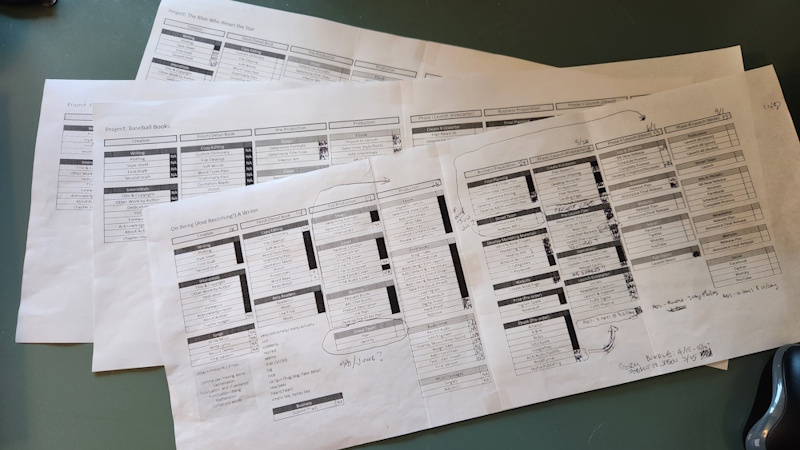
All this to say that I’ve instituted a new tracking process. And I figured today that I’d talk about my current process—which is quite physical and quite visual.
First, a dip into the past:
As I’ve said, I’ve used many different tracking devices in my past, ranging from an intensely detailed weekly and monthly breakdown of each of my projects so I could overlay them in Excel to get a Gantt chart view of things, to a one-pager that worked by simply keeping my eyes on the prize, and trusting I’d get the whole thing done.
When I was in Corporate America, I’d often use Day Planners and roll my writing projects into them as personal tasks.
At one point, I used yellow stickies.
Then there was a time when I had a process where I kept print-outs of three calendar months on my desk, slid under a plastic protective screen. On these, I’d pencil in my plans and update them each week. That was back when I was submitting a lot of short stories to pro markets, so those also included annotations of when I expected stories back. Good times.
The bottom line is that all of these methods worked just fine, but still, I found myself changing them up. Why?
Looking back on it, I think I end up adjusting how I track things because my mind moves. Every planning process has its own pluses and minuses, and, given that, I think my brain gets tired of asking questions that my current planning system isn’t so good at answering. I’m saying that now specifically because of my note that says my current method is quite visual, meaning it’s not hidden inside a computer file. Sure, my current system is printed from a template on my computer, but each of the major projects is in physical form now.
Which means I can’t ignore them like I could if they were simply sitting on a chunk of silicon inside my computer.
How about AI? Can this magic new tech help?
The answer is: yes. AI could help me. I noted late last year that I was going to begin to turn to AI to see if I could make a lot of my grungy work better, and both Chat GPT and Claude have been quite helpful in many places, even though I’m still a mostly blind neophyte. I have spoken with a few writers who have used AI to help straighten their priorities out, so that’s where I turned first. But when I started working with these tools, I felt more anxious rather than less.
The problem was that all the stuff stayed in the computer.
Maybe this sounds weird. It sounded weird to me when I first thought it. But I listened to myself, and came to understand that for me—for where I am right now—I needed to actually see the plan. I needed it in a physical form that made sense. AI was helpful in letting me think about priorities, but it still didn’t make me want to go to work.
All right, so what is this magical system of yours?
So, here’s what I’m doing now.
First, I’ve broken the process of completing a publishing project into eight stages.
Creation (Writing the Book)
Finishing/Detailing (Editing/Beta Readers)
Pre-Production (Book and Cover Design)
Production (Creation and Proofing of Books)
Business Preparation (All-encompassing Term For Many Things)
Phase 1 Launch (Kickstarter)
Phase 2 Launch (Skyfox Publishing Store)
Phase 3 Launch (Wide)
Then I’ve broken each of these eight stages into maybe 15-20 subtasks. The truth is that each of these subtasks has several more subtasks, but at present, my brain can handle this level of abstraction. I’ll note that, as I’m actually working on each task, my daily to-do checklist often delineates the sub-tasks so I can check them off. Perhaps I should put those, too, into this system. Time will tell.
Bottom line: I’ve written the project flow of each book into spreadsheet panels that I create via a template for each project. What makes these magic for me is that I print them all, then tape them together into three-panel fold-outs that I mark up as I go. I start every morning with a scan of the projects, which confirms my priorities and sets my brain on the day’s goals.
Aside: One thing you might note here is that the project has eight stages, only one of which is to actually write the book. I think this is a source of no little angst for Indie writers. Since, in addition to being writers, we are also publishers, the job goes way beyond creating words. This is especially true after a person has a backlist they feel should be managed. If I add up the hours it takes me to publish a full project, at least to publish it as well as I want to publish it, I’m going to guess that the writing part accounts for under 30% of the total hours spent.
This morning, for example,
I chose to focus on the follow-on project that will see “For the Heart of the Game” (which is now available in digital form in the Escape 2026 StoryBundle … more below) given a full Kickstarter release in both paperback and hardcover as I make the entire series available together. So, this morning was fully spent finalizing a rebrand of covers for all three books (See the PEBA on $25 a Day, Chasing the Setting Sun, as well as For the Heart of the Game). For the Kickstarter, they will look like this:

I also took an hour or so to get them all properly loaded to IngramSpark, which is where I fulfill most of my print pledges on Kickstarter. In the next couple of days, I can begin ordering proofs. I know I need to hit a quick turnaround for two reasons—the first being that I want to run this Kickstarter in parallel to the MLB’s All-Star break, and the second being that Brigid and I have super-secret plans to run another Kickstarter out of my account come September. So this one really, really needs to be done on time.
Anyway, you’ll hear more about them and my other projects soon.
The main point I wanted to make here was this.
This is working for me. I say that because before I broke things out this way, and before I printed each so I could look at them as a whole, I felt myself sensing that panic that comes with being overwhelmed. I think it’s because I can see the whole of the work laid out in front of me, and while it’s obviously going to take some nosing to the grind-wheeling to pull it off, I can see the end of each project. The whole thing is finite.
This, too, shall end.
Blah, blah, blah.
I’ve said a million times before that everything about this job of having a life as a writer comes down to being able to keep my emotional mindset in the right place to be able to do the work. The longer I do this, and the more I hear writers talk about the millions of pieces of advice that float around, the more I think this is true. And in that sense, there are almost no bad practices, and no good practices. Only practices that work for you or do not work for you. Even such a radical practice as literally selling your copyright (rather than licensing it) could be a good deal if you were in the right place. I saw a day or two ago that Garth Brooks was seeking something like $2B (yes, B) for his backlist. Maybe that’s a bad deal for him, but if it is, maybe I don’t wanna hear what you consider a good one.
You get the idea, right?
A good planning method helps me achieve what I want to achieve. A bad planning method is one that doesn’t help me.
And the most interesting thing on my mind right now is the idea that sometime soon—I would guess sometime after I get these seven projects through the hoops, this method will begin to drag me down.
And I’ll have to find another.
Or maybe I should say I’ll get to find another?
Because that’s the thing about being an Indie publisher as well as an Indie writer. When I’m in the right emotional framework, running the business can be fun, too.