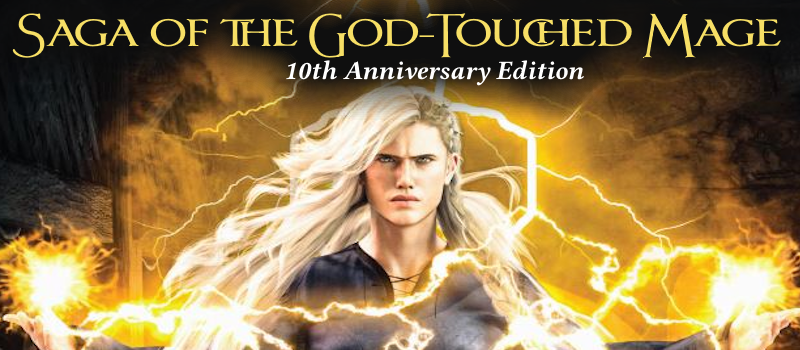
If you follow me at all, it’s obvious that I’ve been putting a ton of work into a super-cool 10th Anniversary release of my Sage of the God-Touched Mage series. The expectation is that the initial release will be via a Kickstarter project starting on July 15th (see the preview here), with the full wide publication happening in October. Yes, it’s getting exciting. I love this story. It was a bestseller when it first came out, and it’s been being read by people for all these ten years, so I don’t think I’m crossing the line to say this story is good.
Will the re-release succeed? I don’t know. But I’ve done everything I could to make the project fun and to make the books themselves into something special. You can see them in many of my most recent posts, so I’m not going to use this post to dwell on that.
Instead, I want to talk about the work it takes to do this kind of thing, or at least the work it’s taken me to do this project. It’s been a lot. Doing a good job on a project—even just a “small” short story collection—always takes some effort, but this is a bigger project. It’s taken a bigger effort. Starting from envisioning the whole thing, through designing the books, structuring the project into Kickstarter language, and then laying foundations to support the project’s runtime, it’s taken … well … we’ll see.
Before I dig in, though, if you are interested in actually running a Kickstarter project, let me point you to an invaluable resource: Anthea Sharp’s Kickstarter for Authors 2025, which, naturally, is Kickstarting now.
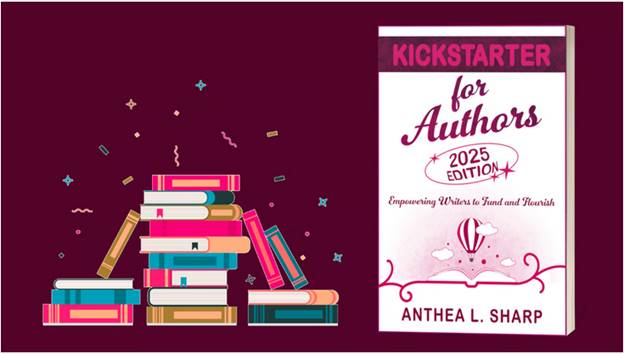
Anthea is a great writer and a better person who works hard to help other writers achieve their goals. I’ve got a copy of the earlier edition. It’s a fantastic book. Please consider supporting her.
On to Saga of the God-Touched Mage, though.
This project unfolded over roughly two years. That’s right; two years. I’m going to break the conversation up into five sections. In each section, I’ll do some estimating of the effort involved.
The Vision
(Effort Minimal)
I’ve had the idea of doing a 10th anniversary edition for some time, which was sparked a few years back when I saw Tom Carpenter, another writer friend, do a similar release on his Alexandria books. The thing that totally set the concept for me, though, was seeing the high-end books that independent publishers have been doing lately. The stuff coming from Bookvault is sooooo pretty. First time I saw one, I knew Garrick had to fall into those kinds of pages.
Re-designing the Books
(Effort: Two Weeks, 60 hours?)
The first issue here was that I wanted to move the books from their original eight volumes into a four-book set. Part of this was presentation. There are pricing advantages to having a bigger book as the entry point to the series. I’m a smarter Indie publisher today than I was ten years ago. Also, as I’ve already blogged about, once I started looking at the stories, I came to the conclusion that the story arcs were actually better off in four volumes than eight.
So I embarked on a week-long effort to put the new package together, which became a full-pass return to the series, effectively doing a fresh-eyed copy edit and a very tiny bit of smoothing a crack here or there. If you’ve read the story before, you probably won’t notice anything, but the prose is just that tiny bit cleaner in places.
I also wrote four new forewords to the four volumes, each in the area of 1,000 words.
Regarding the timeline, much of this work happened in the early part of this year.
Covers & Book Design
(Effort: maybe 20 hours over a long span, Cost of Art: Undisclosed!)
It was over a year ago (early 2024?) when I asked my good friend Lisa Silverthorne if she would be interested in doing the covers for this project. She had been bringing work she was doing for her covers to our weekly writers’ lunch sessions, and I had been drooling over them each time. I was stoked when she said she would.
So, we worked out a price (pay your artists, my friends, pay your artists—especially when they are your friends!), and I set about sending her as many details as I could about Garrick and about the books. She works in a multi-media method, patching 3-D DAZ renders into other elements she licenses from other sites, and of course, she needed to understand what I was looking for. We bounced back and forth on book 1 (which eventually was titled Apprentice Mage, but at the time was not). I’m sure I was a little annoying as I discussed the 3D renders, their expressions, hair styles, and whatnot. Lisa was cool, though. I think we both figured that if we got Book 1 set, the rest would fall out more easily. This turned out to be true.
However, what no one had planned was that things got difficult in my life, and the project took a major back seat for several months. It wasn’t until maybe this past December or January that we finalized all the classic covers and moved into the high-end, amazing, gold-foiled special editions that have captured my heart. Lisa is also amazing in this aspect. Very detail-oriented. My own effort on this part of the project was minimal—a few hours here or there to review her work (which basically consisted of giggling with glee as she showed me what she was doing, and making a suggestion here or there). Her work, I’m sure, was considerably more extensive.
Bottom line, when we were good to go, she hand-delivered files I needed and then helped me get them properly loaded.
In total, over the whole span, I’d say I spent maybe 15-20 hours gathering information for Lisa, discussing my visions, and reviewing work she had done.
Making Sure They Are Right!
(Effort: 16 hours? Cost of Proofs: $250?)
Of course, with physical books, proofs are needed. This project was both pricey and time-consuming because The Saga now consisted of trade paperback, classic hardcover, and deluxe special editions. That’s essentially twelve books to scrutinize. And we found some things to fix in the special editions, so that’s four more. The process varies, of course. And I didn’t read every book line-for-line. But if I say an hour per volume, that’s fair enough, I suppose.
Putting It On Kickstarter!
(Effort: 55 Hours & Counting)
This is the work most people think of when they think of creating a Kickstarter—putting the information into the application in a fun and effective fashion. It’s also the place where Anthea’s book often really shines (but I love her work because it does take a big-picture look at the Kickstarter world for publishers). It is a lot of work for someone like me to put things together because it’s mostly all me, which means I’m often limited by my skillset, especially with graphics. I can fake things by humming a few bars, but I am not a gifted professional digital artist. I also design by trial and error.
For most of my smaller Kickstarter projects, I’d say it takes me a good 20 hours to put the Story together. This one is, obviously, much larger.
Most of that is because I’ve iterated often, including iterations not just on presentations but also on the tiers I was going to offer. What follows will be some elements of that iteration.
My first draft of the reward tiers included additional tiers for Early Bird pricing. I had included them because I’d spent an hour going through other successful projects in the fantasy genre, and I liked the idea at first. Later, I took a Knowledgeable Friend to lunch, explained the project to them, and asked, “How would you do this?” The response made me rethink the idea. So out went the Early Bird offerings.
Aside: taking a Knowledgeable Friend to lunch is a very good thing to do. You get great feedback, share a yummy lunch, and spend time with people you like…total win all around!
My first draft of the reward tiers also included adding shipping to the base cost. I like this for smaller projects specifically, but Knowledgeable Friend made a counterargument that this became messy in big, international projects. Better to do the work it takes to determine shipping rates up front and build them directly into the project. That made sense, and the feeling I got when they said that confessed that my real reason for planning it this way had been to avoid that work. Bad me.
So, yes, I went off and did the work, which then made me need to change the Kickstarter Story draft.
Speaking of the actual Kickstarter Story, the first draft of that probably did take 20 hours or so. It focused on getting nice representations of the books. I wrote lots of bits about the project and the books, and me. And Lisa Silverthorne as the artist. I then sent it to four people I trust and asked for feedback. After making those changes, I sent it through another pass with a different audience. To detail everything I’ve changed from my first draft, second draft, third draft, and beyond would be impossible. But here are some basic areas:
- Despite thinking I’d added tons of graphics, everyone said MORE! So I did.
- I removed easily half the text (and, of course, what remains is so massively better it’s almost embarrassing).
- I’ve added subtle movement in a couple of automated GIFs. Nothing too gaudy, but just a little something.
- I’ve fixed typos (They don’t call me typoman for nothing)
- I’ve improved reward tiers.
- I’ve written and rewritten the project subtitle about 6,398 times. But I think it’s almost good now.
- I’ve rethought some of the presentation on stretch goals, specifically including a video element in each one of them.
- I focused extra thoughts on the Preview page.
I should note that, while I’m still eight days away from launch as I write this, I’ve made one more pass at finding knowledgeable people to take a look at what I think will be my last cycle of the Story (but what I know will be evergreen through the life of the project). So it’s not unexpected that my current estimate of 55 hours expended on the Story will go up.
Laying the Foundation
(Estimated Effort: 30 hours and growing)
If there is one thing I’ve learned about crowdfunding projects, it’s that you cannot communicate enough about them. No matter how much I talk about them, it’s not enough. No matter how much I worry about making people’s eyes glaze over by over-communicating, it’s not enough.
And this is a big project for me.
So, yeah.
Newsletters, naturally. My latest went out this morning and linked to the project preview.
Blog posts, of course. I’ve done four specific videos and four specific posts on the Special Editions and the books for each volume (with one more to go that will post either tomorrow or Wednesday.
In that light, I restructured my website (which, yes, Ron, really does need a total revamp, I say to myself) to support the series in a stronger fashion and highlight the coming release better. I broke the series out into individual pages for each book, and then incorporated them into the Kickstarter Story so people would get more information as along as they didn’t mong story spoilers.
I’ve been on my main social media pages fairly extensively, and have even used the project to expand my reach into Instagram, where I’ve had a presence but never really learned much about it. (I’m sure I’m not going to be effective on that platform right now…and, in fact, I already made lots of mistakes in those posts, but you have to learn sometime, right?).
I’ve talked about it to friends.
I’ll be putting it out to my Patreon peeps later this week.
I’ve gotten the books put into preorder status on all the wide platforms I’m on—with a release date that will be out past when Kickstarter backers will get their goodies, specifically to ensure the my backers know they will be getting something before anyone else, but so folks who don’t do KS can start getting excited.
This release is a big process for me, after all, and Kickstarter is going to be the fulcrum.
I wanted to get out ahead of the game. Hence, I’ve spent what will likely amount to a full 40-hour work week simply laying this foundation.
Now, that said, it was fun work. Doing the videos in particular, where I get to talk about the books and some of the history around the series, is a real blast. I do so love it. I mean. Really, I do.
It’s that love that matters, I think.
Of course I hope the project is a financial success, but the most important thing to me right now is that I do the work and love the work. And if nothing else, I’ll have seen the series I love put into these magnificent books.
That alone makes me very happy.
Summary
(Total Effort To Date: 190 hours)
So, yes. If I add up all these numbers, and add a little pad for the work I’ll likely do this coming week before launch, I get something around 190 work hours that I’ve put into this project. Another writer once told me they value their time at $50.hour, which would mean I’ve put $9,500 in labor into the project. Sheesh.[grin] That makes me feel tired.
And that doesn’t count the work I’ll do to support the project for the two weeks it will run, nor the work I’ll do to fulfill it. I’m going to guess that will be another 60-80 hours across the next couple of months.
Was it wise to put that kind of effort into it? Will I return that kind of response?
I have no idea.
All I can say is that right now, that does not matter. I am a writer—a creative, if I can be a tad pretentious here. I’m doing a project I love because I think it’s great. I’m doing the best I can to present this project to people I think might like it.
And when this project is finished, I’ll do the same thing for the next one.