Young folks today. I tell ya.
I am, slowly, being dragged into the modern age when it comes to talking about books, readers, and storylines. By this, I mean, yes, I’m trying to think about tropes.
The publishing world today seems to revolve around these things, which, in my mind, until recently, were the classic elements of various genres that defined the genre but were considered to be more than a bit tired and worn out. Tropes, when I was coming up, were considered cliché. Things to be avoided, or at least things to be twisted into something different that no one had seen before.
Looking back on it, I don’t think that was ever really true.
I think that was the take of a somewhat cynical and perhaps overly intellectualized element of the industry that didn’t really know its readers. “Don’t just have a dragon in the thing,” a high muckety-muck might say. “Do something different!” As if dragons needed my creativity to be interesting all by themselves. Regardless, that environment imprinted on me, and I can still find myself missing the entire point when it comes to tropes. Which I’m working on because now that I’m quite a distance from the old Traditional framework, it’s clearer to me that this old discussion about tropes was about as misplaced as a properly functioning cell in Elon Musk’s brain.
In today’s world, tropes feel more like movie trailers than anything else, and as with trailers, they come in an infinite array of flavors.
Rather than being just “things,” which was the old conversation, they cover everything from emotions, to locations, to story structures, to themes, to … you name it. Maybe my issue has been the engineer, that part that clings to structure, but now that I’m almost able to break my previous mindset, I see the point and purpose of the idea. These things are not really defined so much as they are birthed from readerships. These things are akin to what my little circle of writer-folk calls reader cookies, which is a term that originated from Gardner Dozois, a longtime editor in the SF field.
Readers decide what they want, and the way we choose to talk about our work lets those readers know if they are going to like what’s inside.
A trope is whatever I decide it is, and then the readers get to say if that’s right.
That makes sense to my brain, anyway.
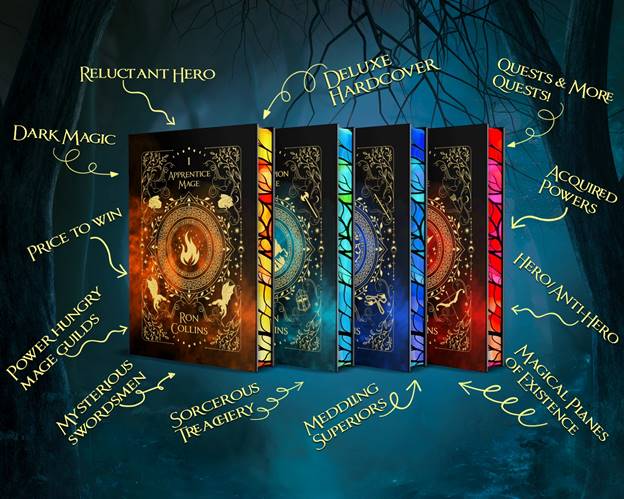
I’m thinking about this because of the 10th anniversary Kickstarter project I’m running for Saga of the God-Touched Mage (which will launch July 15th). When I wrote this series, the idea of focusing on tropes was not in my mind, so when a few folks (yes, Lisa Silverthorne, I’m talking about you!) prodded me to look at the work with fresh eyes and do the work it took to yank out its tropes, I resisted. Because that’s what I do. Get off my lawn, you rascally kids, and take your tropes with you! But Lisa and a few others did not relent, so I took a few deep breaths, set my thoughts on conversations I’ve had with Brigid (my daughter, another great writer), and entered the fray.
Tropes are good things, I kept telling myself.
And, of course, they are. I think it’s vital to understand what your work is about, and the more proper, modern use of the term “trope” really is in line with the concept of developing your elevator pitch—which is also cliché, and which used to be targeted at traditional editors, but is now targeted directly to readers. When I think of it this way, though, I like the concept even better. Readers are the most important element of the whole publishing industry environment. Without readers, we are doomed. So why wouldn’t I talk to them in the same way I’d pitch an editor?

So, I looked at the books, and stretched myself, and I recalled all the ways I’d talked about them. I focused on what made me love them in the first place. Why this story? Why these characters?
I looked at themes and the relationships between characters.
I considered the sources of magic in the story, and about a hundred other things about the work that make me smile. It was work, I’m not going to lie. There are so many moving parts in a story, and removing the binders means everything is fair game. You don’t distill any story into its most interesting parts without doing some serious considering. But, in the end, I came up with the ideas I think are core to Saga of the God-Touched Mage, and that I think readers like. Once I had my list, I sent it to Lisa, who did her magic and came up with the very nice image that adorns the beginning of this essay. If you follow the Kickstarter project, you will see prominently displayed.
I like this.
If you do, too, and you’re intrigued enough to check out the project, you can do so right here: