I spend a lot of time watching the business world surrounding Independent Publishing. This won’t surprise anyone who knows me. I’m a moderately analytical person, and I’m a pure case of an independently published writer—meaning there’s no one here but me. For many of us, the most important word in the phrase Independent Publishing is the first: Independent. That said, we really should spend more time on the second, because when we decide to pursue Independent Publishing, it’s the “publishing” that suddenly defines what we do.
I’ve been thinking about this the past week or two because I’ve had a lot of conversations with writers of all levels about the business.
However, as I walk away from them, it seems clear that many of those conversations aren’t really addressing the entire business of what being a publisher means. When that happens, I leave the conversation with an unsettled sensation in my gut—until, eventually, I end up realizing that my difficulty is that the writers I’m chatting with think they are, indeed, covering the spectrum. Yet they are not.
Here’s what I mean…
What is a Publisher?
Let’s start by asking ourselves, what, exactly, in the traditional publishing model, a Publisher brings to the business arrangement of creating and selling a book to the people who will read it. In other words, what is a Publisher? What does a publisher do? When we make a business agreement with a publisher, what does that publisher bring to the table?
I ask it this way because the job of publishing is the same whether I sign a deal with a Big 5 house or if I do it myself.
Cutting to the chase, the publisher brings two things to the table.
First: The publisher brings capital. By this, I mean that the publisher pays all the development costs, which include advances against royalties to the writer, which keeps the writer alive, but is basically there to aid in the creation process. No writer, no book.
But to a publisher, a writer’s advance is only one slice of the costs associated with a book project.
The publisher foots the bill for everything: editing, book and cover design, developing things the modern world considers metadata, printing, pricing, distribution across multiple channels, marketing, publicity, promotion, and all the other things one might bundle under the term audience growth.
Most of us one-writer publishing houses take what I’ll call The Very Low Cost approach to funding most of these things (including, just not doing them…which is the root of my angst with some of the conversations I’ve had with various writers).
But still, the job of the publisher is to fund all of these things.
That’s part of the deal we make if we sign a contract.
The publisher shall bring a few buckets of cash to these line items.
In this light, though, the second thing a publisher brings to the agreement is the act of project management.
A publisher assigns a person, usually an “editor,” to drive the book through the process.
The “editor” then arranges for all the tasks to be completed, and takes action as needed to keep the book train on schedule.
When we, as writers, sign a publishing deal, our expectation is that the publishing house will handle all of that coordination.
This is literally the piece of the agreement that makes me call what other people call “traditionally published” authors “dependently published.” If I sign a contract to have another company publish my book, I am depending on them to do the work it takes to get the book together. We can break the process it takes to create a book into its sub-parts, and I’m going to do that in a moment, but let me be clear about this right now: I’ve just answered the question I started with:
A publisher is the entity that provides both the capital and the project management activities to the process of creating, distributing, and selling a book.
The end.
A big publishing company may control enough resources that the activities the project manager controls can be performed completely inside that company, but the project manager will outsource things the company can’t do or prefers not to build a capability for in-house.
This is the job we take on when we decide to become independently published writers.
We bring capital investment to our projects.
We agree to manage the project of developing, distributing, and selling our books.
What does this mean?
The Minimum Viable Indie Publisher
The term Minimum Viable Product has its origins in software development, which I was involved in back in the days I worked a day job. Some early independently published writers grabbed it and applied it to the idea of writing and publishing. A Minimum Viable Product book was one that was at least good enough to cross the lowest level of quality to be bought and at least mostly liked.
The term annoyed some of the writers I know, and for reasonable reasons.
But still, it was a valuable tool for people who were breaking into the world of being a publisher.
The idea carried a useful essence of “do the best you can, and don’t sweat it.”
Let’s look at this in terms of the project that is publishing a single book.
First, the tasks: (note that I’ve added the MVP column)
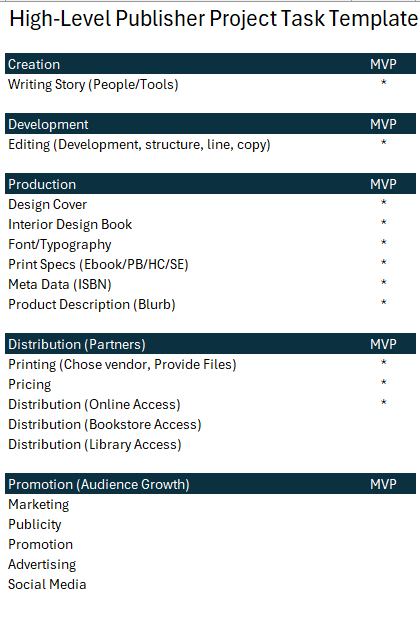
Like all project task lists, this is a simplified presentation, hence the “High-Level” tag I’ve assigned to the title of the table. Still, it works for this conversation.
Look at this breakdown closely.
If you are a publisher, your project includes acquiring rights to publish a book that someone else wrote—so in that sense, the point here is that they are outsourcing the job of writing. They contract for that talent. Arguably, they could just offer a writer a full-time job with a 401K and healthcare, right? It’s not done today, but it is a possible method (and arguably, that’s what we are doing for ourselves when we publish independently).
If you are a publisher, you are paying people to do developmental editing, line editing, or copy editing of your work. Yes, some writers who go the traditional route will hire developmental editors, or ask friends to go over their work, or whatever…but when they do that, they are doing it in hopes of attracting a publisher. Assuming they are successful, the publisher will still run the manuscript through their own editing process.
Run down that whole list.
Note that in this viewpoint, it is the publisher that is making all of the decisions.
Sure, we, as the writer, choose our stories, but the publisher is choosing us.
The publisher, through the art they commission, decides what goes on the cover.
The publisher decides how the book will be configured. The publisher is responsible for getting the marketing positioning done, for deciding its pricing, for deciding what distribution channels the book will go into, and for getting it into them.
Blah, blah, blah.
I’m not railing against Traditional Publishing.
Instead, I’m trying to point out that when we, as independent publishers, begin to branch out from the writing part of the business, we are no longer operating as writers. We are 100% operating as publishers.
And in that light, we get to choose the end state of the project.
Note the MVP column in that table.
A not-completely-unreasonable argument can be made that an independently published writer can eventually succeed by doing nothing but making great books and publishing them without any fanfare. This approach depends completely on word of mouth. It can happen. Authors like Colleen Hoover (who was beginning to sell books even before her TikTok community roared) and Andy Weir show it can happen fairly quickly. Others show slow-burn projects can result in big numbers over the long haul, even if they start small.
That’s an analysis based on survivor bias, of course.
We don’t see the ten kabillion writers who published quietly, then go away.
Still, that’s a viable model.
And, with the exception that you have to use at least one publishing platform, often just Amazon, you can choose to do every step in-house yourself, essentially for zero cost of capital.
Write the book yourself, edit it using every tool and trick you can gin up, configure the book design in whatever word processor you use, make a cover in a free graphics design program (using your own skill and taste), develop your own metadata, write your own sales blurb, decide the pricing, then push the book out to the distribution platform you choose.
That, my friends, is the Minimum Viable indie Publisher.
It’s really quite attractive to us because it greatly reduces the need to use tools outside of the book itself to do our marketing.
Write a good book, this MVIP idea says, and everything else will take care of itself.
Of course … that doesn’t “work” as well as it once did.
I think there’s a reason why the term Minimum Viable Product appeared in publishing circles when it did—during those early, gold rush years of the Amazon/Kindle release.
That was an era when supply did not meet demand.
An era when readers would scan the lists.
When Amazon pushed high-volume releases rather than steady long-tail success.
The idea still “works,” because there are really very few ideas that never work.
That said, I see independently published writers who have been pursuing the MVIP approach for some time turning bitter. Heck, many who branch out are turning bitter. Success in this business is, in reality, super hard—partially because there are no guarantees. Even writing a great book alone carries no certainty, because there’s a lot of randomness to this signal, and a lot of noise in the air. Not only does a great book have to find readers, it also has to find the right readers.
When you overlay the fact that a book is such a personal thing, the wall of rejection that surrounds the business can feel omnipresent.
The obvious answer is to begin working in every one of the buckets.
If you’re a traditionally published writer, that’s the approach you’re working in. Or, at least, that’s the approach you should be able to reasonably assume. Since the publisher brings both capital and project management to the deal, you are within your bounds to expect your publisher to bring enough capital (financial and human) to the game that they can push all the buttons in all the boxes.
Of course, they may not be doing that at all, but that’s the deal you’ve made (in spirit, if not in fact—read your contracts!).
If you are an independent publisher, though, you still have what I’ll call the requirement to push all the buttons in all the boxes.
All with only 24 hours in a day.
It’s a Sisyphean task.
Hence, bitterness when it doesn’t work out.
The problem is that, in that tiny little task list I posted above, the world is really complex.
If you’re hearing a writer who advises “Don’t worry about anything except writing the next book,” you should probably look the other way. But when you hear a different writer advise you to “follow their mindset that covers all the bases,” you should probably run away, too.
That said …
Here’s my advice
Split yourself into two people. When you’re writing, think like a writer. When you’re not writing, think like a publisher.
I think you should have a tool or a process you’re using in every box of the chart.
Yes, you should distribute your books in ways that make sense for them. Wide? Kickstarter? Kindle Select? They can all work. But know why you’re doing it in whatever way you’re doing it. Be intentional.
Yes, you should try to do publicity of some type.
Yes, you should advertise.
Yes, you should ….
That doesn’t mean you should use one tool or another. There are, as my grandfather would say of the poor feline species, more ways than one to skin a cat. And there are probably an infinite number of ways to spend zero, or very few, dollars to do something that fits into every bucket.
When I split myself into my publisher mindset, I’m asking myself how much of my time and money I’m going to spend in each bucket. For my tolerance of risk, I prefer to keep my financial cost low and to spend my sweat equity whenever possible. But when I spend money, I’m looking at the whole of my job as a publisher.
When I look at a task (let’s take on marketing and advertising, which is always a drain for us writers, but really shouldn’t be for us publishers), I’m asking what tools I’m using in that space, and what I need to do to expand my reach. Sometimes what I need to do is to learn a new skill. Sometimes it’s just that I need to do a trial. Sometimes it’s both. I’ve been fiddling with Facebook ads earlier this year, for example, limiting spend as I learn.
The point, though, is that when we are acting like a publisher, I think it’s important to think like a publisher.
That’s what my writer-self expects, after all.
My writer-self delivers manuscripts to my publisher-self with the full expectation that my publisher-self is going to do a professional job of both creating and publishing the book.
Over time, the Minimum Viable Independent Publisher approach might well work.
But, while I can’t afford to let my publisher take over all 24 hours of my life, I do expect my publisher to do more than the minimum.