I spend an hour a day invested in something related to AI. Often more than an hour. By “invested in” I mean anything from listening to people discuss how they use it, absorbing news and opinion, scanning different people’s output (sometimes on purpose, other times not), and using the tools myself.
I’ve been open about my policy.
I am not anti-AI. I am not blind to its value. I haven’t used it while creating my fiction simply because I enjoy writing my own work. But I’m not worried if someone else uses it to make their stories because—for me—the proof is in the output. If AI makes writing better, that’s good. If you’re using it as a shortcut, I suspect you’ll pay the price as a lack of quality.
Whatever.
Life is short. It’s all good. You do you.
I have also, however, been public about my interest and willingness to use AI in any way that will help me do parts of the job I’m less excited about or less skilled at. For example, I recently used AI for a final copyediting pass on a manuscript before sending it to my human copy editor (who, as luck has it, is my sweetie for life). I’ve always used basic spell-checkers, Word’s Grammar checker, and—over the past couple years—Grammarly, as prep for a final read-aloud process before giving my work to Lisa—who is literally a New York quality copyeditor. This time I also gave Chat a pass at it, too.
After reading it, Lisa’s response was (1) the manuscript still needed work, but (2) wow, this was the cleanest manuscript I’ve ever sent her.
In other words, using AI helped me find errors.
That sounds like a valuable tool.
AI is, of course, controversial.
Creative people are struggling to figure out how to deal with it.
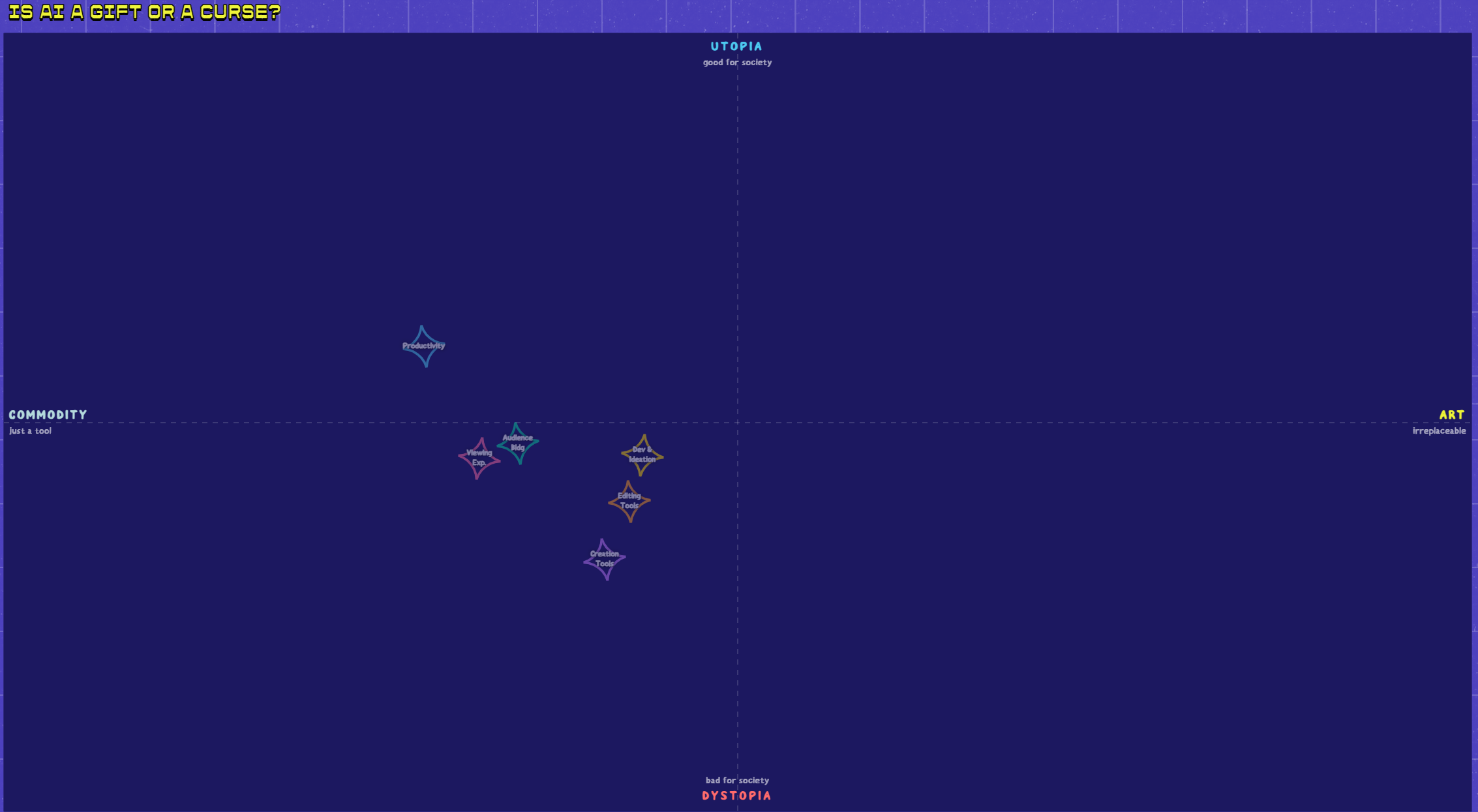
Today I came upon an interesting site that asks the question: Is AI A Gift or A Curse, and attempts to quantify how the creator community feels about using AI in various aspects of their work. This tool is linked to Digital Spaghetti, a site I wrote about in my last post, and is likely heavily influenced by filmmakers and video people. The results, however, feel transferable and are fascinating.
As of the time I came upon it, the data comes from a tabulation of 563 creators.
To put it simply, you take the survey by placing twenty aspects of the creative process onto a graph with the axes Utopia/Dystopia and Commodity/Art.
Given the flexible nature of those categories, if you get the idea this isn’t a precise measurement, you’re not wrong. There are also places I needed to make assumptions about what these things mean because, again, this was focused on video creators (and I am a writer).
But, for its mushiness, I still find it interesting.
The system leaves us four quadrants to assign how we feel about the use of AI for these tasks:
· Artistic and Moving toward Utopia
· Commodity and Moving toward Utopia
· Commodity and Moving toward Dystopia
· Artistic and Moving toward Dystopia.
The tasks in question fall under the sub-categories of Productivity, Development and Ideation, Creation, Editing, and Viewing Experience.
I’d suggest taking the survey simply because it’s fun. When you’re finished with it, you can compare yourself to the rest of the community, as well as a few of the specific responders..
Regardless, though, let’s walk through where the four quadrants fell out:
NOTE: THE IMAGE AT THE TOP OF THIS POST IS THE “OVERALL” RESULT
Quadrant 1: Artistic and Utopian
It’s not surprising that the creative community as a whole did not put anything in this quadrant. I’m not particularly excited about AI in my creative space, so I interpret this as matching my viewpoint. I should note, however, that I personally put a few things in this quadrant, right on the edge. Things like making storyboards, and video transitions, and using AI to help make product descriptions. I interpreted using AI on these tasks as augmentations, however, not push-buttons.
That said, I was fascinated to see that the specific creators identified included several items in this area. So that shows a dichotomy of opinion.
Quadrant 2: Artistic and Dystopian
This is an interesting quadrant to think through.
What does that mean? What would you actually put there?
Two of the three people you can compare to placed “Reply to Commentors” very high in the “Art and Dystopia” category. I considered those acts commodities (because communication is not making art) and dystopian (because I hate the idea of personal contact through automation). So…yeah…what do we mean?
But here’s something especially interesting about this quadrant: These people who focus on making videos grade the use of AI for writing scripts and making storyboards as (barely) artistic, and only gently Dystopic. I put making music for videos in this category, but I’m sure if I took the same thing blind again tomorrow it might be in a different place. This is interesting.
Think about this, though.
On average, video people consider using AI to write scripts as somewhat artistic.
On the other hand, a bit ago, I (a writer) just said that using AI to make video transitions could be artistic. Does it mean something that practitioners of one art form see getting help doing things that practitioners of another art form more routinely do as aiding their artistry?
Seeing how a few other specific creators responded here makes issues with the survey mechanism even more obvious.
It’s quite the question.
Quadrant 3: Commodity and Dystopian
It’s not terribly surprising to see the creator community places a lot of tasks in this quadrant. Perhaps the most interesting item of all was the placement of the use of stock video moderately high toward the Dystopic axis. I expected it to be moderate on the commodity scale, but was unaware that anyone in the creative community had what I’ll call a moralistic issue with the use of stock art. Yet, there it is.
The obvious suspects are here, though.
Training AI, using AI generators, AI music, and complete replacement of editors all score as highly Dystopic.
Other items—use of it for identifying trending videos or personalizing algorithms—were only barely Dystopic, which is interesting. I would have thought that would be more worrisome, but on the other hand, the creative community is making a lot of their day-to-day living via these algorithms, so there’s that, too.
Finally, we come to what, for me, is the most interesting quadrant…
For my money, this is the Green Zone.
I want AI to help me do basics.
The easier AI can make the nuts and bolts of running the business, the more Utopian I’ll grade it.
I included things like using AI as an Analytics Advisor, Research Assistant, and Notetaker very high in this quadrant. I was pleased to see the creator community does, too.
I like that.
I also like seeing that the community included things like product descriptions as gently Utopian. I see those as a bit of an art form, but this community considers them to be a commodity. The community also gently accepted the use of AI to generate chapters (which I think means helping them create some structure in their work), do generative fills, analyze trending ideas (an item I’m unsure of), and do video transitions and relit scenes.
Final thoughts:
Bottom line: if we take this collective of 563 people as a baseline, it says that the use of AI is finding its niche (as should be expected) in the areas that it can be actually helpful to us—that being to remove drudgery or, even better, accelerate our understanding of things.
Yes, I like that.

Note: My new fantasy The Price of Vengeance, is getting its exclusive soft-launch now as part of the Bundle of Bundles StoryBundle. Something like 47 books in a package that, to a degree, anyway, you can pay what you want and direct how your cash will be distributed. That’s something I love about the whole StudyBundle business model.
The Price of Vengeance is the first book in what’s planned as a three-book series, and it explores exactly what the title suggests it does. And, since this is a bundle of bundles, you also get Apprentice Mage (Book one of my Saga of the God-Touched Mage series), and Five Magics, my first collection of fantasy stories.
If you’re interested, check it out!
