(Or AI, Readers, Quality, and Witch Hunts)
It’s come to this.
I had an argument with a friend last week.
It started as a conversation about the Anthropic case, but was probably fueled by the whole maelstrom surrounding AI in the creative community as it stands today. Specifically, it was about whether fair use was even ruled upon, and what it means. We’ll get into that, again, in a bit. My position—though, for some reason, still mostly ignored among certain sets of writers—was not wrong. Fair use was ruled, and in subsequent conversations when cooler heads prevailed, my friend agreed with me. But I am also not particularly proud of myself for letting it get to that emotional state.
I admit I’m a little tired of thinking about AI in the arts, but the topic is pretty much impossible to avoid right now.
Maybe that’s because being a writer defines a large part of my personal echo chamber. The algorithms are strong in this one, right? Maybe it’s because I make serious attempts to stay informed about AI in the big picture in real time. I mean, news about real progress is everywhere I look now. But people are mad, because of course they are. The tide of the AI wave is coming in much faster than the legal system can respond, and the overall impact of AI is hitting a point in the real world where things are being felt. The temperature of vitriol is hotter than it has ever been, and even though I think it shouldn’t be, the vitriol from creators is quite ugly.
It’s to the point that several high-profile writers I know are afraid to openly talk about AI for fear of being cancelled by classic mobs of self-appointed vigilantes.
Writers eating writers is bad.
Very bad.
Especially since, in the end, I project the argument to be a nothingburger. Or at least a nothingburger argument between writers.
AI is gonna AI.
We should be pointing our angst elsewhere.
But that’s another conversation, and today I want to push a few pieces together to see if I can come up with a practical assessment of where the world might really be when it comes to AI integration into the arts.
Clarity is important.
Because it seems like we have to, let’s start by looking at some rulings.
Regardless of what any writer might say, legal arguments are being gathered and processed. I think it’s helpful to face them for what they are.
To focus this conversation, I’ll address three basic questions that are driving complexity into our conversations: (1) Are AI companies required to get consent from authors to use their books to train LLMs? (2) Are writers breaking copyright if they use AI to do their work? (3) To what extent do authors hold copyright on material they write while assisted by AI?
I’ve written on #3 before. The effective answer is yes, kind of. The US Copyright Office has stated that authors hold copyright on material they create, but not on material AI creates. So, if we push a button on Claude or ChatGPT, and take whatever the AI creates, then we have something in the public domain. We can still try to sell it, of course, but cannot claim it as our own and have no protection against “theft.” But, if a writer uses AI and makes extensive adjustments, the writer can still receive some form of copyright protection. The hard part of this is that the Copyright Office has not provided specific guidelines on these assessments, which makes it a “I know it when I see it” kind of situation.
Joy.
Regarding #2, US courts have ruled that use of AI to create text is not copyright infringement. At least they have thrown those arguments out of cases that have brought them. So, if a writer uses AI to support their writing, in the legal sense of the term as it stands today, that writer is not stealing anything. Of course, if they use AI to create a work that strongly resembles the latest Dean Koontz or Nora Roberts book (or yours or mine, for that matter), then they are in jeopardy—just as that writer would be if they typed the manuscript with their grubby little fingers.
Issue #3, regarding training of the LLMs is a little messier.
Two US courts (in cases involving Meta and Anthropic) have ruled that AI companies using legally acquired work to train their LLMs is fair use. This is a fact. It is also a fact that the rulings are weak in that they are not yet precedent. Things could change. Against that state, though, the notorious ruling and subsequent settlement regarding the use of pirated copies throws a small spanner in the works. Some seem to be using that settlement to pretend the fair use ruling doesn’t exist—and that’s a problem. The game is far from over. In fact, it’s in its early minutes. But the Anthropic settlement of $1.5B is arguably a big win for AI companies because, while it slaps their hands for using pirated work, it leaves the fair use ruling intact.
The OpenAI case is likely next in the chute. It’s probably even more complex. I note, too, that a German court (in a case involving video generation with Suno) has gone the other direction, a decision that will be appealed, I’m sure.
The landscape is still complicated.
But…
Despite the vitriol being hurled by worried writers (or perhaps because of that same vitriol), I think it’s important to understand that the AI companies are winning their core arguments more than they are losing. At the end of the day, these cases are NOT slam dunks for writers.
Beyond this, these legal cases—of which there are many—are moving slowly while, at the same time, every frontier lab in the world, including Chinese groups, is releasing new models every few weeks.
And with every release, the models get demonstrably better.
How much better?
Well…
Let’s talk about the perception of quality.
I belong to the Alliance of Independent Authors (ALLi), which puts out a series of podcasts. One, hosted by Dan Holloway, covers news items related to the world of publishing. A week or so ago, he discussed the results of an interesting academic study designed to determine if 1,600 readers could tell the difference between fictional stories of human authorship and those of AI (in this case, ChatGPT 4.0). The study also addressed whether these same readers enjoyed human-authored stories more or less than stories from AI. If so, why?
The link in the last paragraph leads to the dry 20-page academic report, so be prepared. In my job back in Corporate America, I spent many hours reading these kinds of things. So, wonky idiot that I am, I found digging into it kind of fun. Your mileage could differ.
Bottom line…comparing three AI-authored stories to three stories that had been written by humans and published in literary venues….
- Readers had a worse-than-random chance of identifying AI-written stories.
- Readers generally rated AI-authored stories as somewhat better than human-authored stories.
- But when those readers were told a story was human-authored, they rated that story as better than one they were told was created by AI … even when they were lied to. In other words, the idea of human authorship alone made readers raise their scores.
It’s worth noting that a sub-section of this study was focused on how people with self-reported literary and technical backgrounds fared in identifying AI. The answer was that those with tech backgrounds were correct barely over random (51%), while those with literary backgrounds were far worse. In other words, no one could really tell anything, but literature experts were the worst of all.
Yes, it’s one survey.
Maybe it’s wrong.
But this response fits my view of what the future will bring—which is that readers, in general, will prefer human authorship and are most likely to gravitate toward it.
Note: most likely is not guaranteed.
I expect there will be a market for AI-generated work (more on that in a moment), but, as long as a human can write an engaging story, and as long as that human can be human in the eyes of the market (regardless of what tools that author uses), AI will not keep us from finding readers.
This makes sense to me.
Perhaps this is just my bias showing through. Time will tell, of course. But if this read of this is right, then I’ll stick with my best guess.
Humans like to watch humans. It may be what we do best.
A different framework?
Because fandom is fandom, right?
Pulling the argument out of the arts, let’s think about the situation around sports.
The latest wave floating around my social media is videos from the Chinese robot competitions. Little steel people running and jumping. Which, assuming you can get out of Terminator mindset, is quite cool. I assume you’ve seen them. If nothing else, they’re posted to show the humorous ways the bots crash into things after they break a human record.
I mean, I’m sure there will be a market for robot competitions.
There already is, actually. Robot battles have followers, as do things like eSports (though eSports are human at their core … which maybe makes them an even better example).
But I don’t think the NFL has to worry about their fans running off to watch robot football any time soon. This is because the purpose of mainline sport is to accentuate human stories. It’s to build identity. This is why sports fandom is among the most bloodsport of all stans. All you have to do is watch the Olympics for an hour to understand how human connection drives everything. Sport is about human drama. People will stop watching when the drama goes away.
Same, I think, for fiction.
In my mind, readers will always gravitate to stories with human origins (even if they are facilitated by using AI in some fashion).
Here is maybe the first fully transparent case of this.
Aside: yes, I know I’m wrong about this…I’ve heard several people discuss publishing work with an AI. This is the most aggressively direct example I can recall, though.
In this sense, our goal as writers—whether using AI for anything or not—is to be as open and as outwardly human as we can. This has always been true, of course. But the existence of AI creates the need for us to actually say it.
Let’s talk about the market as a whole.
All right then, while the previous section was about whether AI can actually replace a human when it comes to the quality of our work, and answers that question with “technically yes, but operationally, not really,” let’s take another step up the ladder and talk about my expectation that “there will be a market for material written with AI.”
Earlier this year, I said my only prediction for 2026 was that we would find out if there is a market for AI-based art. I can now say the answer seems to be “why, yes, there is, and, depending on how you cut it, today that market seems to be roughly 30-60% of the public.”
From what I see myself across a collection of platforms, I would go a little lower. But I’m picking that range based on a survey done by Luminate, in which roughly 30% of respondents were comfortable with AI content in various media types (news, music, and video games, for example), and another 30% didn’t care one way or the other. Roughly 40% were either uninterested or very uninterested (an exception was video games, where the sway toward AI content being acceptable was 10% stronger).
You’ll need to follow the link to see all the questions, but as one example:
How interested are you in watching a movie/TV show written using gen AI?
- Much Less Interested: 25%
- Slightly Less Interested: 14%
- Neither More Or Less Interested: 33%
- Slightly More Interested: 17%
- Much More Interested: 11%
As with all these things, the source of the results can and should be argued. Was the sample size representative? How would it play across international boundaries? And, even if the sample size is good, this is just one survey…so take it as you will. Repetition of results is key.
That said, it’s interesting to note that headlines reporting these findings all read like the data says people are rejecting AI, when in my view of reality—especially given this is a new technology—I’d say the data is representing a very rapid adoption curve.
I mean, the technology has only been here for a brief while, and it’s only been “good” for part of that time. If I were the head of an AI company, I would be thrilled with these numbers.
While it’s fair to say that the 39% of responders who were less interested in material made using generative AI is higher than the 28% who were interested in it, that ignores the inconvenient fact that 61% of the market was either fine with it (the 33% “just give me a good story” crowd) or were actively interested in it (that 28%).
Despite the headlines, this data does not say people as a whole are rejecting content made using AI.
This is a snapshot, though.
For my money (and if I were the head of that AI company), I would want to take this same survey every quarter to see how the numbers shifted over time.
When I put the study noted above and this survey together, the result continues to back up the idea that the general public is fine with artists using AI but will prefer that the human behind it remain human through it all—that people who make push-button “art” are unlikely to draw eyeballs for very long but that artists who find ways to incorporate generative AI that makes their work better are likely to find audiences waiting for them.
Finally, let’s talk about the Witch Hunt (and the use of detectors).
Here are a few items at semi-random.
At least two multi-million-dollar traditional publishing contracts have recently been very publicly killed because their writers were accused of using AI to generate text. Another writer won a prestigious award despite being accused of using AI after the initial award tier was announced. Each of these writers disputes the claims, but, in the context of where the future is going, the first of many issues that comes to me is: assuming the writers did use AI to generate text, how did these stories manage to get through the vetting process before being given contracts or awards? (I’m tempted to reply “See above” … that the writing and stories were “good enough,” whatever that is).
The question I’m focusing on right now, though, is why so many writers are so quick to pile onto these writers before they even determine what the truth is. In this environment, tagging a writer as using AI can carry very harsh consequences. Shouldn’t we defend writers first?
I guess not.
We are a motley crew, it seems. Not ones for solidarity or unions much, and then once we get into them we seem to spend half our time trying to decide who belongs and who doesn’t.
Sigh.
I should note that personally, I could care less if a writer chooses to use AI.
My own personal statement remains as it always has been (simplifying for this piece): I don’t care to use it to create text, but I’m deeply interested in exploring ways I can use it to run my business better. If I decide to use AI in my text, I’ll be open with it, but for now the closest I’ve come is the pre-human copyediting I discussed in an earlier post.
But even if I had stauncher opinions there, I’d still be horrified seeing what’s happened to these writers—all of whom have been deemed guilty and made to pay an emotional penalty regardless of what they’ve said, and two of whom have lost both big paychecks and their reputations (while publishing houses move merrily along).
Talk about your Red Scare.
My goodness, people, have you no humanity?
In this world of vigilante vitriol, being socially accused of using AI can be a harsh thing.
Worse, some of these writers noted that the accusations can come with the at least somewhat warranted concern that people of color are under an even greater microscope than the norm (and the norm is bad enough).
My personal hot-take is that until a writer is proven to be in breach of their contract, any other writer should be livid at the publishing house. I have no idea what their contract says, and until it is revealed, neither do you.
Which then brings me to the question of how anyone can tell if a work has used AI?
And don’t give me “detectors.”
On a social media platform I belong to, a set of anxious writers recently weighed in to say they had run their self-authored work through a collection of AI checkers, and had the system tell them they had used AI—sending them into an even more frantic state of worry. The public outcry swirling around such accusations weighed heavily on these writers. It was their work, after all. Many of those pieces were written before AI ever existed.
After seeing this, I ran an old story of mine through a couple of the more popular detectors and received responses that all said I was a human (thank goodness!).
Some, however, pointed to sections that were the most suspect for being generated with AI.
Interesting.
I honestly don’t know what to make of that. I should probably write about those sections and what that might mean to me as a writer, but that’s for another post.
Instead, I want to talk about detectors themselves, and how dangerous they are.
Here’s a quick-and-dirty view of basic detector math.
Let’s assume that we are the publisher of a high-end genre magazine, and to make the math clean, we get 10,000 subscriptions in a year. I used to focus heavily on the short fiction market for science fiction. Unless something has changed in the past ten years, that’s a fair estimate.
For the argument, let’s say only 10% use AI.
Let’s also say we don’t like AI, and we worry that our audience will not like AI either, so we decide to use a detector to weed out the offenders.
What happens next depends on how accurate the detector is.
In this case, here are some possible results:
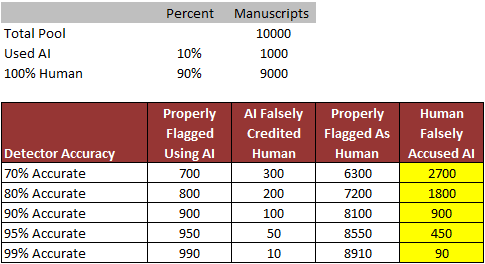
So, if we assume we have a near-perfect detector (99% accurate), we catch 990 of the offending 1,000 AI manuscripts, but ten make it through. That is, however, still worrisome because now that we assume those ten are all human-created, what happens next? If they are all “good” (as the study above says they might well be) and we assign them human origin, there is a reasonable chance that we will publish at least one story that has AI in its origin.
Far worse, though, is the other side of the table, where even at that best 99% accuracy level, we have 90 writers per year falsely labeled as using AI.
In other words, this scenario has a false positive for AI 9x larger than the false negative.
I hear you. Or maybe I do. What happens when the AI numbers get huge? What if 50% of submissions are AI? Let’s run those numbers:
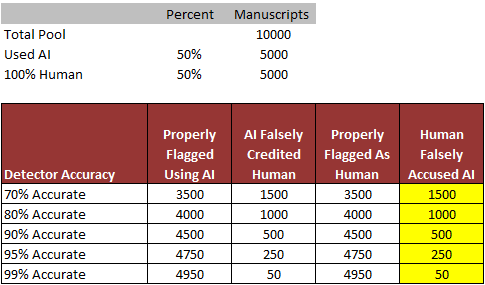
At 99% accuracy, we falsely accuse only 50 writers of using AI, but now we’ve let 50 stories into the fold. Is this better? I suppose that depends on who you are, but to me it’s a losing game either way. Bottom line: the more manuscripts you get, the more likely you’ll publish stories touched by AI.
The far better question, though, is about that 99%.
I’ve seen vendors claim 99%. Do you trust them?
I want to. I mean, I really do want to. But I don’t.
Even Anthropic’s watermarking thing—which is definitely interesting—is really only good at finding push-button users or users that barely touch text they receive from AI. Maybe that’s good enough. In fact, if one says we don’t really care if someone uses AI to help them, this watermarking is arguably a great tool because it would be pretty good at weeding out raw spammers and low-effort beginners.
But our exercise is predicated on driving the entirety of the scourge that is AI out of our pile, so we need to find all AI use.
Anyway, my pure guess is 95% to 97% is about as good as you’ll ever get (if that), and looking at those numbers in the tables above makes me question why anyone would want to rely on a detector at all.
There has to be a different way.
If you are a writer, you should be worried about the witch hunt.
The puzzle pieces I’ve laid out here come together to say we will live and succeed with our humanness—as we always have. And in that light, the whole witch hunt going on now should make us shudder.
Did these writers use AI?
I have no idea, and (again) neither do you.
But it shouldn’t matter to us.
If another writer uses AI to create actual copies of my work, I’ll get worked up about it. Of course I will. I don’t like seeing shops pirate my Stealing the Sun series—though in my case they get away with it because I’m way too small to afford to send a cease-and-desist letter to every group I discover. Instead, a decade ago I created my personal Piracy Policy.
Otherwise, I don’t see why I should care.
The courts will say who owns copyright.
The market will say what art is commercially valuable.
Even if further courts uphold the current rulings that AI companies can train on legally obtained copyrighted material, the system will be the same.
Perhaps you will argue that no one will be able to tell which category you fit into (push-button, AI-facilitated, or 100% human)—which seems to maybe be the real problem here. A whole cadre of writers are running around saying that AI cannot replace them, yet are targeting others with enough vehemence to make me assume they don’t believe what they’re saying.
Because the way you prove to people that you are human is by being human.
Openly.
Fully.
Sincerely.
But that is not enough, of course. Not enough to guarantee success.
As a low-profile, independently published writer who has been working in the field for a long time, I can report that drawing attention from readers who will like your work is a tough gig. It’s always been tough and always will be. The existence of writers who use AI in a push-button fashion will not change that equation at all because they are unlikely to hold any attention they attract.
Oddly, though, writers who use AI in ways that make them better writers will not change it either, because their success is theirs. In fact, one of the things I like most about the field of fiction is that the more interesting books that get written (whether with AI or not), the bigger the pool of readers grows. This means that while ultimately, my equation is my equation and your equation is your equation. The success of other writers, however, helps me simply by increasing the size of the market.
Either way, though, the job I have is the same whether other writers use AI or not—write the stories I love writing, then get those stories in front of people who might like them.
I see no reason to shame someone else for their approach.
That said, I’m annoyed at myself for the argument I got into.
Not because I was wrong—which, again, I wasn’t—but because there wasn’t any reason to raise the heat of the argument. We chatted later. We’re still friends. It’s all cool.
It’s helpful to share real facts to counter misunderstandings, especially if we are teaching other people. But when we’re dealing with a world full of fear and ego, that can be difficult. It is important that we can share our understanding of what is real with less vitriol, though.
In the end, it really doesn’t matter what people think will happen, though, because the world will march on and, in that marching on, will resolve the situation.
But it does matter how we treat each other.
And life is short.
It’s up to all of us to keep from doing each other harm in the process.
I have to laugh–one of the big areas that I got flagged by one of the AI programs was an area where I used Kris’ skippable paragraph and summarized what had happened in the book before. This was before AI and was in the book that I await Anthropic’s settlement on, but I found it interesting that summary was one of the highest flagged areas.
I was pleased that the AI detector offered to humanize the work for me… :).
However, I am uncomfortable when I see people on social media claiming something someone else shared is clearly AI based only the way it was written. There is, as you said, no real way to tell. A friend is often accused of that. She writes essays now and again on social media. As she’s an environmental activist and her concerns about AI are primarily around the environmental impact and the bias implicit in what it’s learning, she gets a lot of vitriol when she’s accused. Yet, she doesn’t use AI. She’s someone who has had to write a lot of clear instructional manuals and procedures in her offline life. Apparently that makes her sound like AI–or should I say, AI sound like her.
Hi, Bonnie. My initial reaction to your comment about AI flagging the “skippable” paragraph is that, in general and by definition, the skippable paragraph is going to be exposition…and that exposition can be boring.
I’m stretching here, but I’m tempted to say that what AI detectors might really be useful for is identifying parts of our manuscript that are less interesting than other parts. In other words, what they find for us are places where our writing itself is not really in our voice, if that makes sense. I say that partially because in the sections I noted above where AI pointed to the most suspect parts of my own work, they were transitions, bits of exposition, and other bits that I could look at and say … “hmmm…I could probably have done better there.”